
Offshore Legal Staffing: What the Ethics Rules Actually Require

Every attorney who asks me about offshore support asks the same three questions, usually in the same order.

Is it allowed. Who's responsible if something goes wrong. And do I have to tell my client.

Those are the right questions, and it's striking how hard it is to get straight answers to them. Search the term and you'll find a dozen providers explaining how much you'll save. Almost none of them mention that the American Bar Association addressed this in 2008, that Illinois has its own opinion on it, or that in Illinois you probably owe your client a conversation before you start.

In full disclosure: Amata's staffing model includes employees in Colombia and the Philippines alongside our Chicago team, so we sell this. Which is exactly why I'd rather write the version that tells you what your obligations are than the version that tells you what you'll save. If you engage anyone for offshore support — us or somebody else — and you haven't handled the items below, the exposure is yours, not the vendor's.

One note before we start: this is general information, not legal advice. Ethics rules are jurisdiction-specific, the opinions below are advisory rather than binding, and your own bar's requirements govern. Confirm anything that matters with ethics counsel.

What is offshore legal staffing?

Offshore legal staffing is the use of legal support personnel located outside the United States — paralegals, legal administrative staff, document reviewers — working on a U.S. law firm's matters under the supervision of a licensed attorney at that firm. It is a delivery model, not a category of legal service.

The distinction that matters throughout: these are support staff performing work under supervision. They are not practicing law, and describing them otherwise creates a problem that has nothing to do with geography.

The market is substantial. Estimates for global legal process outsourcing run between roughly $20 billion and $30 billion for 2024–2025 depending on which research house you ask, with offshore delivery accounting for somewhere near 77 to 79 percent of it. Thomson Reuters' 2025 Legal Department Operations Index found 43% of chief legal officers planning to send more work outside their organizations — seventeen percentage points above the prior year.

So this is no longer novel. Large firms and corporate legal departments have done it at scale for two decades. What changed recently is that it became viable for small firms.

Is offshore legal support ethical?

Yes, with conditions. ABA Formal Opinion 08-451 states that a lawyer may outsource legal and nonlegal support services, domestically or overseas, provided the lawyer remains ultimately responsible for delivering competent representation to the client. Every state authority to address it since has reached the same conclusion.

That opinion, issued in August 2008, is the foundational document. Its requirements, in plain terms:

Competence stays with you. Under Model Rule 1.1, you remain responsible for the quality of the representation regardless of who performed which task.

Supervision stays with you. Rules 5.1 and 5.3 require reasonable efforts to ensure the provider's conduct is compatible with your own professional obligations.

Disclosure and consent. The opinion says appropriate disclosure should be made about the use of outside lawyers and nonlawyers, and consent obtained where they will receive information protected by Rule 1.6.

Conflicts screening. The provider must not be working for adversaries on the same or substantially related matters.

Reasonable fees under Rule 1.5.

No assisting unauthorized practice under Rule 5.5.

The opinion also acknowledges directly that overseas arrangements make supervision harder — distance, time zones, differing legal systems — and recommends reference and background checks on the provider.

Several state and local bars addressed overseas outsourcing specifically, and the pattern is consistent: permitted, but treated as higher-risk than domestic, warranting clearer consent and tighter access controls. Florida Bar Opinion 07-2, North Carolina 2007 Formal Ethics Opinion 12, and New York City Bar Formal Opinion 2006-3 all land there. Florida's opinion is notable for stating expressly that nothing in it should be read as an endorsement, and for directing lawyers to familiarize themselves with the privacy laws of the offshore jurisdiction.

Do I have to tell my client?

In Illinois, ordinarily yes. ISBA Opinion 19-04 states that when a lawyer outsources legal or legal-support services, including to other countries, "disclosure to, and informed consent by, the client will ordinarily be required." It is always required where a lawyer transfers complete or substantial responsibility for a matter to an unaffiliated lawyer.

This is the question providers skip, and it's the one with real consequences.

That last point comes from Illinois Rule of Professional Conduct 1.2(e), which is unusual — most states don't have an equivalent, and Illinois has had it since 1980. Worth knowing if you practice in more than one jurisdiction, because the Illinois requirement is stricter than the baseline.

North Carolina goes further still, requiring the client's advance informed consent. New York City's opinion requires securing consent before disclosing confidential information to a foreign provider.

What generally drives whether consent is required:

Does the provider receive confidential client information? If yes, Rule 1.6 is engaged and consent moves from advisable to expected.

Is the work substantive or ministerial? Purely administrative support under close supervision is treated more like an in-house assistant. Substantive legal work is not.

How is it billed? Separately billed or marked-up arrangements attract more scrutiny than costs passed through at actual cost.

My practical advice: have the conversation. Attorneys tend to assume clients will object, and in my experience clients mostly want to know that someone competent is doing the work and that their information is protected. A client who finds out later, from someone else, reacts very differently than a client you told up front.

Who supervises the work?

You do. Under ABA Model Rule 5.3 — adopted in substance in Illinois — a lawyer is responsible for the conduct of nonlawyers working on their matters, and that obligation does not transfer to a vendor. No contract term, indemnity, or service agreement changes it.

The 2012 amendments to Rule 5.3 added commentary addressing nonlawyers outside the firm specifically. What the required supervision looks like scales with circumstances: the education, experience and reputation of the nonlawyer; the nature of the work; the terms of any arrangements protecting client information; and the legal and ethical environment of the jurisdiction where the work is performed.

That last factor is the one that makes offshore different from domestic. You're expected to have thought about the enforceability of confidentiality obligations in the provider's country.

And the duty doesn't end at vendor selection. Illinois guidance is explicit that protecting client information requires ongoing monitoring, not a one-time due diligence exercise.

What this means practically. A good provider makes supervision workable — detailed work logs, matter-level reporting, a named person you can reach rather than a support queue. A poor provider stays vague about it and lets you assume the obligation went away. It didn't.

How is confidentiality protected?

Rule 1.6 requires reasonable efforts to prevent unauthorized disclosure of client information, and that obligation applies identically whether the person handling the file sits in Chicago or Bogotá. The safeguards ethics authorities expect are specific and worth asking about directly.

From the opinions across jurisdictions, the expected controls are:

  • Written confidentiality agreements with the provider, with remedies for breach
  • Access limited to only the information needed for that specific matter — and explicitly no access to other clients' files
  • Secure transmission and storage, encryption, access controls, passwords
  • Conflict-check questionnaires
  • Background and reference checks on the provider and any intermediary
  • Documented supervision
  • Attention to the data-protection regime and enforceability environment of the provider's jurisdiction

One structural point that gets missed. Florida's opinion specifically addresses subcontracting chains — the provider you vetted may not be the entity doing the work. Ask directly whether any portion is subcontracted, and to whom.

That isn't hypothetical. The clearest documented offshore confidentiality incident involved a medical transcription chain: in 2003, a Karachi-based transcriptionist at the end of a three-subcontractor chain threatened to post UCSF Medical Center patient files publicly over a pay dispute, and emailed actual files to prove she could. UCSF had not known the work reached overseas at all. It isn't a law firm case, but the failure mode — a chain nobody had mapped — transfers directly.

Can I bill offshore support to my client?

Yes, with a distinction that matters. Under ABA Formal Opinions 93-379 and 00-420, a firm may bill outsourced work as a legal fee and charge a reasonable total including overhead and profit. Pass the same cost through as a disbursement and you may charge only actual cost — unless the engagement letter disclosed a surcharge up front.

Almost nobody writes about this and it's a genuine trap.

The practical rule: if you intend to profit from delegated work, bill it as a fee, with the total reasonable under Rule 1.5. If you bill it as an expense line, bill what it cost you — unless you disclosed a surcharge in the engagement letter and the client agreed to it. Presenting an undisclosed markup as a disbursement is the version that creates a problem.

Employee or contractor: the distinction that matters most

Whether the offshore staff are employees of the provider or independent contractors sourced through a marketplace changes your risk profile more than which country they're in. An employer-of-record model produces enforceable contracts, stable assignment, and accountability. A marketplace produces neither.

This is where I'd focus evaluation, and it's the part rate comparisons obscure entirely.

A marketplace or contractor model refers you to independent workers. They can take other work, leave without notice, and are typically not covered by the platform's insurance. Confidentiality obligations run to individuals you have no relationship with. Turnover is high, which means the institutional knowledge that makes support valuable never accumulates.

A direct-employee or employer-of-record model means the provider legally employs the person in their own country. The employment contract carries confidentiality and intellectual-property terms enforceable there, and that person is assigned to your firm rather than shared. Supervision has somewhere to attach.

Rule 5.3 asks you to weigh the provider's arrangements protecting client information. A marketplace's answer to that question is structurally weaker than an employer's, regardless of price.

Five questions worth asking any provider:

  1. Are the staff your employees, or contractors you refer to me?
  2. Is any part of the work subcontracted, and to whom?
  3. What is your vetting process, in actual steps?
  4. What confidentiality instruments bind them, and are those enforceable in their jurisdiction?
  5. Do you carry professional liability coverage on the people doing my work — in writing?

What actually goes wrong

The documented failures in offshore support trace to unmapped subcontracting chains, undefined task boundaries, and supervision that existed on paper only — not to the location of the worker. The evidence base is thinner than either advocates or critics suggest.

Two incidents are cited repeatedly, and both are worth knowing accurately.

The 2003 UCSF transcription case described above — a subcontracting chain the client institution didn't know existed. And in 2005, employees at a call center in Pune, India stole roughly $350,000 from four Citibank customers by obtaining PINs during support calls; more than a dozen people were arrested.

Neither is a law firm. Both are about controls, not geography.

What I'd want you to weigh honestly: I could not find a U.S. bar discipline case or malpractice judgment squarely attributed to offshore supervision failure, and no case treating properly supervised offshore support as unauthorized practice of law. The one lawsuit that tried to enjoin foreign legal outsourcing was voluntarily withdrawn in 2008.

But absence of reported cases is not evidence that the risk is small. It reflects limited public reporting and the general difficulty of enforcement in this area. I'd rather tell you the record is thin than tell you it's clean.

Independent comparative quality data — offshore versus domestic legal support — essentially doesn't exist in public. Nearly every "quality maintained, costs cut 50 to 70 percent" figure you'll encounter comes from a vendor. Including, to be fair, from vendors like us. Treat all of it as directional.

A note on our own arrangement

I opened by disclosing that we sell this, so it's fair to say plainly what we do.

Our offshore team members in Colombia and the Philippines currently provide executive assistant and administrative support, engaged full-time through employer-of-record partners who serve as the legal employer in-country. Paralegal work, and anything touching privileged client files, is performed by Chicago-based staff. Each offshore team member signs a non-disclosure agreement directly with us before starting.

So the chain runs: client → Amata → employer-of-record partner → the individual. Three links beyond you, each under written agreement.

I'm spelling that out because earlier in this piece I told you to ask every provider for exactly that. It would be a poor article that made the case and then dodged the question. A provider who tells you there's no chain either hasn't looked, or is hoping you won't.

Frequently asked questions

Yes, with conditions. ABA Formal Opinion 08-451 permits outsourcing legal and nonlegal support services domestically or overseas, provided the lawyer remains ultimately responsible for competent representation. Every state authority to address it since has agreed. The conditions concern supervision, confidentiality, conflicts, disclosure, and fees.

In Illinois, ordinarily yes. ISBA Opinion 19-04 states disclosure and informed consent will ordinarily be required when a lawyer outsources legal or legal-support services, including overseas. It is always required where an unaffiliated lawyer assumes substantial responsibility for a matter.

The supervising attorney at the firm. Under ABA Model Rule 5.3, adopted in substance in Illinois, a lawyer is responsible for the conduct of nonlawyers working their matters. That obligation does not transfer to a vendor by contract, indemnity, or service agreement.

Written confidentiality agreements, access limited to only the matter at hand with no access to other clients' files, secure transmission and storage, conflict screening, background checks, documented supervision, and attention to the data-protection and enforceability environment of the provider's jurisdiction.

They can perform substantive legal support work — drafting, research, document review, case management — under attorney supervision. They cannot exercise legal judgment, give legal advice, or perform any act reserved to licensed attorneys, and describing them otherwise raises unauthorized-practice concerns.

It depends on how you bill it. Under ABA Formal Opinions 93-379 and 00-420, work billed as a legal fee may include overhead and profit if the total is reasonable under Rule 1.5. Cost passed through as a disbursement may be billed only at actual cost, absent advance disclosure of a surcharge in the engagement agreement.

A marketplace refers you to independent contractors who can take other work and leave without notice, often outside the platform's insurance. An employer-of-record legally employs the person in-country with enforceable confidentiality terms and assigns them exclusively to one firm, so supervision and accountability have somewhere to attach.

The most cited incidents are a 2003 medical transcription case involving an unmapped subcontracting chain and a 2005 call-center fraud in India. Neither involved a law firm. No U.S. bar discipline case appears squarely attributed to offshore supervision failure, though thin reporting is not proof of low risk.

Not currently. Our offshore team members provide executive assistant and administrative support; paralegal work and anything touching privileged client files is handled by Chicago-based staff. That reflects where the model stands today rather than a permanent limit, and we'd rather say so than imply otherwise.

India pioneered the market and still leads by volume, the Philippines is the fastest-growing Asian provider, and Latin America — Colombia, Mexico, Argentina — is increasingly favored for U.S. time-zone overlap and bilingual capability. Which fits depends less on the country than on the provider's structure and controls.

E-filing can generally be handled remotely. Physical court runs, Clerk's office trips, and courtesy copies to chambers require someone in the building, so those need local staff regardless of provider. Any provider claiming remote coverage of physical courthouse tasks is worth a direct follow-up question.

The version nobody sells you

Twenty-four years in, having supported more than 1,800 firms, I've come to think the offshore conversation gets framed backwards.

It's usually presented as a cost decision with an ethics footnote. It's actually an ethics decision with a cost benefit — and the firms that treat it the second way get better outcomes, because they ask harder questions before signing and end up with providers who can answer them.

The rules aren't obstacles here. They're a checklist. Written confidentiality terms, matter-scoped access, no unmapped subcontractors, documented supervision, a conversation with your client. A provider who can satisfy all five is a provider worth having. One who can't is going to be cheaper, and you'll find out why.

Ask these questions of whoever you're evaluating. If you want to test them on us first, we're at 312.924.0200 or [email protected] — and if the answers don't satisfy you, don't buy.

Ron Bockstahler is the founder and CEO of Amata Law Office Suites, a vendor member of the Chicago Bar Association, supporting Chicago-area law firms since 2002. He co-hosts The 1958 Lawyer podcast.

Amata Law Office Suites is not a law firm and does not provide legal services to the general public. All legal support services are performed under the supervision of a licensed attorney in good standing. This article is general information about professional responsibility rules, not legal advice. Ethics requirements vary by jurisdiction, the opinions discussed are advisory rather than binding, and your own state's Rules of Professional Conduct govern. Confirm your obligations with ethics counsel.

Sources: ABA Formal Opinion 08-451 on outsourcing legal and nonlegal support services. ABA Model Rule 5.3 on nonlawyer assistance. ISBA Opinion 19-04 on outsourcing legal and legal support services. Florida Bar Opinion 07-2, North Carolina 2007 FEO 12, and New York City Bar Formal Opinion 2006-3 on overseas outsourcing. ABA Formal Opinions 93-379 and 00-420 on billing for outsourced work. Illinois ARDC on attorney registration and discipline. Market sizing figures are third-party research estimates and vary by source.
Paralegal vs. Legal Assistant vs. Legal Secretary: What Each Role Actually Does

A few years ago I sat in on a conversation between two attorneys at one of our locations — both solos, both about five years in, comparing notes on staffing the way people compare notes on contractors.

One of them said she'd hired a legal assistant. The other said he'd hired a paralegal. They spent about ten minutes describing what their person did, and by the end of it, it was obvious to everyone at the table except the two of them that they had hired essentially the same role and were paying meaningfully different rates for it.

Neither of them was wrong, exactly. That's the strange part. The titles genuinely overlap, firms use them inconsistently, and Illinois — like most states — does not license or certify paralegals, so there's no bright regulatory line to point at. The result is that two attorneys can use the same word to mean two different jobs, and a third can use a different word to mean the same one.

Which sounds like a semantic problem until it costs you money. Then it's a business problem.

In full disclosure: Amata staffs all of these roles, and has since 2002. So I have a stake in you understanding the difference. But the direction of my bias might not be what you'd assume — the most common mistake I see is attorneys paying paralegal rates for work a legal secretary should be doing, and that mistake costs a firm more than it earns us.

Here's the actual breakdown.

What is a paralegal?

A paralegal performs substantive legal work under the supervision of a licensed attorney — drafting pleadings and discovery, conducting legal research, reviewing and summarizing documents, managing case files, and preparing for trial. Paralegal work is billable to clients because it is legal work, not administrative work. It is not, however, the practice of law.

That last sentence is the whole role. A paralegal can draft the motion; only the attorney can decide whether to file it. A paralegal can research the standard; only the attorney can advise the client on what it means for them.

The billability point is worth dwelling on, because it's where most of the economic value sits and where attorneys most often leave money on the table. In Missouri v. Jenkins (491 U.S. 274, 1989), the U.S. Supreme Court held that in statutory fee-award cases, paralegal time is compensable at prevailing market rates rather than at the employer's cost. The reasoning has shaped how courts and clients treat paralegal billing ever since: substantive legal work delegated to a qualified non-lawyer is legitimately billable.

So when a paralegal drafts your discovery responses, that time can generally appear on a client invoice. When your legal secretary calendars the deposition, it generally cannot. Same office, same day, two very different lines on a bill.

Illinois does not license, certify, or register paralegals — there is no state credential and no exam. Certification exists through voluntary national bodies like NALA and NFPA, and it signals training, but it confers no authority. What actually governs the work is your supervision obligation as the attorney, which is a professional responsibility you cannot delegate to a staffing provider.

What is a legal assistant?

A legal assistant supports a law firm with a blend of administrative and light substantive work — client intake, file organization, correspondence, document assembly and formatting, scheduling, and billing support. In practice the title is used loosely, and at some firms "legal assistant" means what another firm would call a paralegal.

The American Bar Association has historically treated "legal assistant" and "paralegal" as interchangeable, which is a large part of why the market is confused. Many job postings use them synonymously. Many firms do too.

Here's how I'd suggest you handle it, because arguing about the dictionary is a poor use of your afternoon. Ignore the title and ask what the person will actually do. If the role involves drafting, research, and document review, you're hiring paralegal-level work regardless of what the business card says — and you should expect paralegal-level rates and paralegal-level supervision. If the role is intake, scheduling, correspondence, and keeping the files straight, you're hiring administrative support, and you should not be paying a premium for it.

At Amata we price this distinction explicitly rather than leaving it to interpretation: administrative support runs $70 an hour, paralegal support runs $90 an hour. Not because one person is better than the other, but because the work is different and one of them is billable.

What is a legal secretary?

A legal secretary handles the clerical and production side of a law firm — document formatting and production, calendaring and deadline entry, filing, transcription, phone coverage, correspondence, and court filing logistics. The role is administrative by definition and does not include substantive legal work.

The title has fallen somewhat out of fashion, which is a shame, because the function has not. Somebody has to produce the documents, keep the calendar accurate, and get things filed on time. At a lot of small firms that somebody is the attorney, at two in the morning.

The distinction from a legal assistant is genuinely blurry and getting blurrier. Historically the split was that a legal secretary produced documents and a legal assistant managed the client relationship and file. In 2026 most small firms have collapsed the two into one role, and that's usually fine — as long as you're not also expecting substantive legal work out of it.

Paralegal vs. legal assistant: what's the actual difference?

The difference is whether the work requires legal judgment that an attorney must review before it leaves the office. A paralegal drafts pleadings, researches issues, and reviews documents — work that is billable and that requires attorney supervision. A legal assistant handles intake, scheduling, correspondence, and file management — work that is administrative and generally not billable.

Two practical tests I'd offer.

The invoice test. If you couldn't defend the line item to a client or a court, it isn't paralegal work. Calendaring is not billable. Drafting the notice of deposition generally is. If you can't imagine writing it on an invoice, don't pay paralegal rates for it.

The review test. Ask whether the output needs your professional eyes before it goes out. An appointment confirmation doesn't. A discovery response absolutely does. Everything in the second category is paralegal work, and everything in that category is also your professional exposure — which is the part attorneys underweight.

The failure mode runs in both directions and the costs are asymmetric. Paying $90 an hour for calendar management wastes money, and it's the more common error. Handing document review to someone trained for administrative work is rarer but much worse: you'll spend attorney hours fixing it, and you've put work product at risk in a way that implicates your own obligations rather than the vendor's.

Legal secretary vs. paralegal: what's the difference?

A legal secretary produces and processes documents; a paralegal produces legal work product. The secretary formats the brief, files it, and calendars the response deadline. The paralegal researched the argument and drafted the first version. One role is production, the other is substance.

This comparison is cleaner than paralegal-versus-legal-assistant because the titles have drifted less. If someone's day is document production, calendaring, filing, transcription, and phones, that's a legal secretary function whatever you call it — and it's a genuinely valuable one that many small firms staff too late.

Paralegal vs. lawyer: what a paralegal cannot do

A paralegal cannot practice law. Specifically: no giving legal advice, no representing clients in court or at depositions, no accepting cases, no setting fees, and no signing pleadings. Those five things are reserved to licensed attorneys, and delegating any of them is unauthorized practice of law — with the attorney bearing responsibility.

This is the highest-volume version of this question that people search, and it usually comes from one of two places. Sometimes it's a client wondering whether they can hire a paralegal instead of a lawyer to save money. Sometimes it's an attorney working out how much they can safely delegate.

For the client version: no. A paralegal cannot represent you, cannot advise you on your rights, and cannot take your case. Independent paralegals who offer document preparation directly to the public occupy genuinely contested legal territory that varies by state, and in Illinois the safe answer is that legal advice requires a licensed attorney. The ARDC is the body that enforces this.

For the attorney version: you can delegate a great deal, and most firms delegate too little. A paralegal can run discovery, draft nearly everything, manage the file, prepare exhibits, and handle client communication that doesn't cross into advice. What you cannot delegate is judgment, and what you cannot delegate is the responsibility for supervision — under ABA Model Rule 5.3, adopted in substance in Illinois, you are responsible for the conduct of the non-lawyers working on your matters.

That rule is also the honest answer to the question attorneys are usually really asking, which is whether outsourcing creates risk. It creates a supervision obligation. That obligation is manageable with work logs, matter-level reporting, and a person you can actually reach — but it does not transfer to a vendor, and any provider who implies otherwise is telling you something untrue.

Law clerk vs. paralegal

A law clerk is typically a law student or recent graduate doing research and writing under attorney supervision, usually temporarily and often as part of their training. A paralegal is a career professional whose role is ongoing. The work overlaps substantially — both research, both draft — but the trajectory and the permanence differ.

In Illinois, law students can perform certain supervised functions under Illinois Supreme Court Rule 711, which is a genuinely different authority than anything available to a paralegal. If you're weighing the two: a law clerk brings current legal research training and leaves in a year. A paralegal brings institutional knowledge of your practice and stays. For most small firms the paralegal is the better investment, because the compounding value is in someone who knows how your cases actually run.

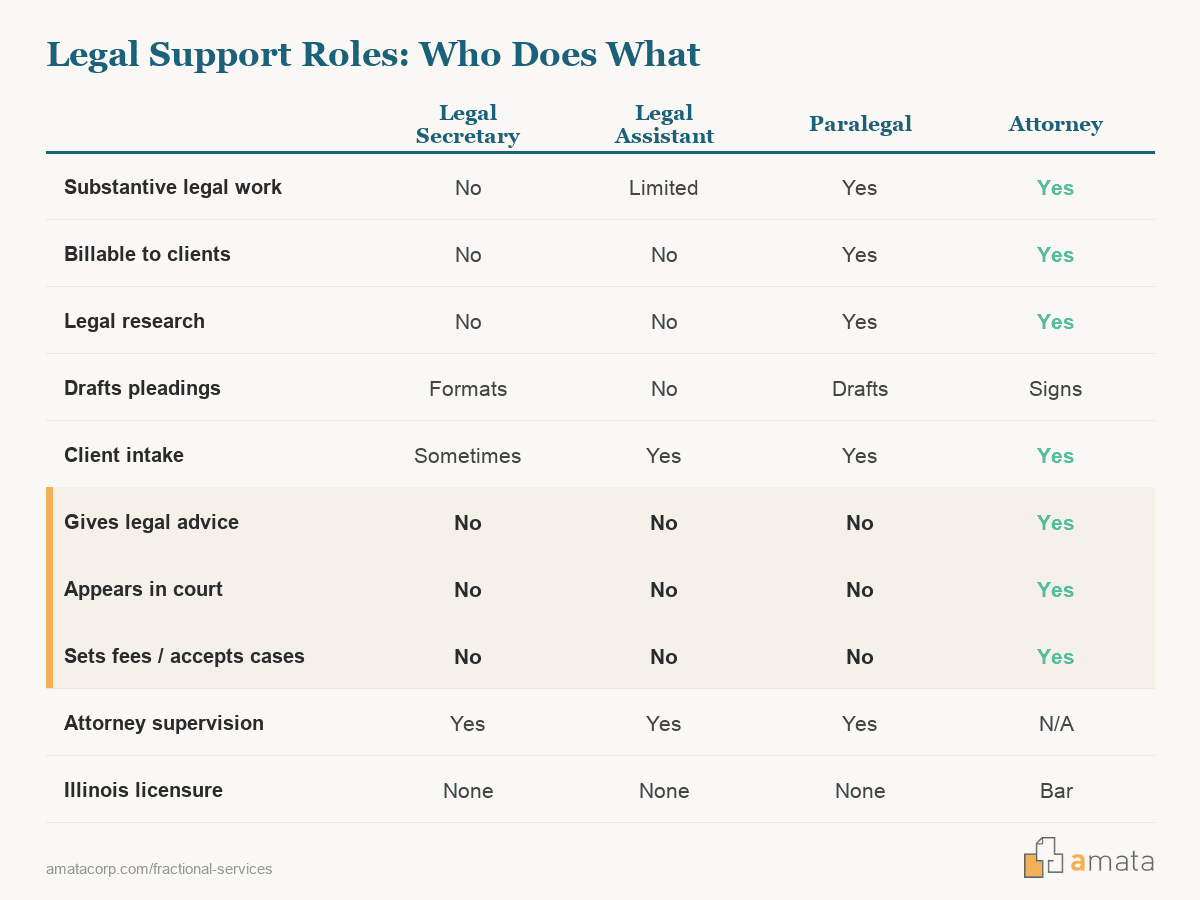
The comparison, side by side

Four-column chart comparing legal secretary, legal assistant, paralegal, and attorney across substantive legal work, billability, legal research, drafting, court appearance, and Illinois licensure
Legal secretaryLegal assistantParalegalAttorney
Substantive legal workNoLimitedYesYes
Billable to clientsGenerally noGenerally noYesYes
Legal researchNoNoYesYes
Drafts pleadingsFormats themNoDrafts themSigns them
Client intakeSometimesYesYesYes
Gives legal adviceNoNoNoYes
Appears in courtNoNoNoYes
Sets fees / accepts casesNoNoNoYes
Requires attorney supervisionYesYesYesN/A
Illinois licensureNoneNoneNoneIllinois bar admission
Typical Amata rate$70/hr$70/hr$90/hr

The three bolded cells in the paralegal column are the ones that matter legally. Everything else is a question of economics and fit. Those three are a question of professional responsibility.

Which role does your firm actually need?

Most small firms need administrative support first and paralegal support second — in that order — and hire them in the reverse order. The instinct is to hire for the legal work because that feels closest to the practice. But the hours that disappear first are usually intake, scheduling, filing, and follow-up.

Try this before you hire anything. Write down every task you personally did last week that someone else could have done. Then sort the list into two columns: work that needed your legal judgment and work that didn't. Total the hours in the second column and multiply by your billing rate.

Two things usually happen. The number is larger than expected. And the second column is overwhelmingly administrative, not substantive — which tells you what to hire.

If the substantive column is the fat one, you need paralegal support. If it's the administrative column, you need administrative support or, at a more senior level, executive assistant support. Most firms need some of both, which is why we don't make people choose one and sign a year for it.

And if you can genuinely fill forty hours a week, every week, hire someone full-time. A fully utilized employee is the better economic answer, and anybody who tells you otherwise is arguing against arithmetic. Fractional staffing exists because most solo and small firms cannot fill those hours — not because full-time employment is a bad idea.

Frequently asked questions

A paralegal performs substantive legal work under attorney supervision — drafting, research, document review — and that time is billable to clients. A legal assistant handles administrative work: intake, scheduling, correspondence, and file management. The titles are often used interchangeably, so evaluate the actual duties rather than the job title.

No. A legal secretary handles document production, calendaring, filing, transcription, and phone coverage — administrative and clerical work. A paralegal produces legal work product: drafts pleadings, conducts research, reviews documents. The secretary formats and files the brief; the paralegal drafted it. Only paralegal time is generally billable to clients.

No. Giving legal advice is the practice of law and is reserved to licensed attorneys. A paralegal also cannot represent clients in court, accept cases, set fees, or sign pleadings. Delegating any of those constitutes unauthorized practice of law, and the supervising attorney bears the professional responsibility.

Not for legal representation or advice. A paralegal cannot advise you on your rights, appear in court on your behalf, or take your case. Independent document-preparation services exist in contested legal territory that varies by state. In Illinois, legal advice requires a licensed attorney in good standing.

Generally yes, when the work is substantive legal work rather than administrative. In Missouri v. Jenkins (1989), the U.S. Supreme Court held that paralegal time is compensable at prevailing market rates in statutory fee-award cases. Administrative time — calendaring, filing, phones — is generally not billable.

No. Illinois does not license, certify, or register paralegals, and there is no state exam. Voluntary national certifications through NALA and NFPA signal training but confer no authority to practice. What governs the work is the supervising attorney's professional responsibility, which cannot be delegated to a vendor.

A law clerk is usually a law student or recent graduate doing supervised research and writing, typically temporarily as part of their training. A paralegal is a career professional in an ongoing role. The work overlaps, but in Illinois, law students may perform certain functions under Supreme Court Rule 711 that paralegals cannot.

A licensed attorney in good standing. Under ABA Model Rule 5.3, adopted in substance in Illinois, an attorney is responsible for the conduct of non-lawyer assistants working on their matters. That obligation applies equally to in-house staff and outsourced providers, and it does not transfer to the vendor.

Usually administrative support. The hours that disappear first for most solos are intake, scheduling, filing, and follow-up rather than substantive legal work. List every task you did last week that someone else could have done, sort by whether it needed legal judgment, and hire against whichever column is larger.

Amata's published rates are $70 an hour for administrative support and $90 an hour for paralegal support, billed in sixth-of-an-hour increments. Monthly programs run $980 for twenty administrative hours, $1,650 for thirty executive assistant hours, and $2,520 for forty paralegal hours, with 32% off hourly rates.

The part that actually matters

Twenty-four years in, having supported more than 1,800 firms — roughly 800 attorneys and professionals are in our community right now — I've stopped believing that the title question is the interesting one.

What's interesting is that most attorneys carry an enormous amount of work that somebody else could do, and they carry it because sorting out who should do what feels like one more project on a list that's already too long. So they keep doing it themselves, and the hours go somewhere, and the practice grows slower than it should.

You don't need to solve the taxonomy. You need to write down what you did last week and be honest about which parts required a law degree.

Talk it through with us: 312.924.0200 or [email protected]. We'll tell you which role you actually need, including when the answer is one we don't sell.

Ron Bockstahler is the founder and CEO of Amata Law Office Suites, a vendor member of the Chicago Bar Association, supporting Chicago-area law firms since 2002. He co-hosts The 1958 Lawyer podcast.

Amata Law Office Suites is not a law firm and does not provide legal services to the general public. All legal support services are performed under the supervision of a licensed attorney in good standing. This article is general information, not legal advice.

Sources: Missouri v. Jenkins, 491 U.S. 274 (1989) on paralegal billing. ABA Model Rule 5.3 on supervision of non-lawyer assistants. Illinois ARDC on attorney registration and discipline.

Outsource Paralegal Services: What Law Firms Should Know Before They Do

Most firms that outsource paralegal work don't decide to do it. They back into it.

A trial gets moved up. Someone goes on leave. A matter comes in bigger than expected. The attorney needs forty hours of document review done in a week, doesn't have forty hours, and starts looking for someone who does. That's the moment — not a strategic planning exercise, just a Tuesday where the math stopped working.

Which is why the decision usually gets made badly. Under pressure, with no time to evaluate providers, the firm picks whoever answers the phone and can start Thursday. Sometimes that works out. Often it produces work that has to be redone, and the attorney concludes outsourcing doesn't work — when what actually didn't work was choosing a vendor in ninety minutes.

In full disclosure: Amata provides outsourced paralegal support, so I have a stake in how you answer this. But I'd rather you evaluate it properly and pick someone else than hire us in a panic and leave in two months.

What are outsourced paralegal services?

Outsourced paralegal services let a law firm access substantive legal support — drafting, discovery, document review, legal research, case management — without hiring a full-time employee. The work is performed under the supervising attorney's direction, and the firm pays for hours used rather than carrying a salary.

The model has been standard in large firms for decades. What changed is that it became viable at the small-firm scale, because providers stopped requiring minimums that only made sense for firms with fifty attorneys.

What services do paralegals provide?

Paralegals handle legal research, drafting and document preparation, discovery management, client interviews, file organization, exhibit preparation, and trial support. They are not attorneys and cannot give legal advice, but they are trained in legal procedure and perform substantive work under supervision.

The core responsibilities break down roughly as follows.

Legal research. Researching facts, gathering evidence, tracking current law and any amendments that affect an open matter.

Drafting and document preparation. Legal proceedings generate an enormous volume of paper. Paralegals draft pleadings and discovery responses, organize forms, and manage filing.

Discovery management. Organizing productions, reviewing documents, building privilege logs, and tracking what's been produced and what's outstanding.

Client interviews and communication. Paralegals conduct client interviews and handle communication that doesn't cross into legal advice. They're bound by the same confidentiality obligations as any member of the firm — an outsourced paralegal is not an employee, but is held to the same standard of confidentiality.

Administrative support around the matter. Scheduling, correspondence, and coordination that would otherwise consume attorney time.

What are the benefits of outsourcing a paralegal?

Outsourcing paralegal work is generally more cost-effective than hiring, provides scalability that matches an uneven caseload, and frees attorney hours for billable work. Firms pay only for hours used rather than carrying salary, benefits, payroll taxes, equipment, and office space through the slow months as well as the busy ones.

While it's clear that law firms benefit from paralegal support, that support doesn't have to come from an in-person, full-time employee.

It costs less than hiring. Outsourced paralegals don't require benefits, payroll taxes, bonuses, or insurance coverage. The arithmetic is simple: work that doesn't require an attorney shouldn't be billed at attorney cost. Depending on how you bill, delegating that work can save your clients money too — which is a better conversation to have with a client than a rate increase.

It improves the client experience. Firms using outsourced paralegals provide more consistent support, faster response times, and more attorney attention on the substance of a matter. When attorneys aren't absorbing routine paperwork, they put that energy into building the case.

It scales. Because outsourced paralegals are engaged as needed, firms can match support to actual workload — which matters most during a seasonal spike or a trial. In twenty-four years I have never met a small firm that knew how many paralegals it needed. Caseload moves. Hire too many and you carry payroll through the slow months; hire too few and the work lands back on the attorney. Nobody guesses that number correctly, which is the actual argument for not having to.

That last point is the one small firms feel hardest. A full-time paralegal delivers roughly 173 hours a month whether you have 173 hours of work or 60. Outsourced support scales down in the slow months, which is exactly when a small firm can least afford to be carrying capacity.

And the cost of getting it wrong shows up in utilization. Clio's Legal Trends research puts solo practitioners at roughly 2.9 billable hours in an eight-hour day — about 37% of the workday captured as billable time. That gap isn’t talent. It’s infrastructure.

What tasks can an outsourced paralegal handle?

An outsourced paralegal can handle any substantive legal work that doesn't require the attorney's own judgment or physical presence — drafting, research, discovery, document review, case management, exhibit preparation, and client communication short of advice. What they cannot do remotely is anything requiring someone in the building.

That distinction is where firms get surprised, so it's worth naming.

Cannot be done remotely by anyone: court runs, Clerk's office filings, Vital Records requests, courtesy copies delivered to chambers, physical presence at trial or deposition. If a provider tells you they cover those remotely, they don't. At Amata that work is handled by on-site Chicago staff, because there is no remote version of walking a document to the Daley Center.

Should never be delegated at all: legal advice, court appearances, accepting a case, setting a fee, signing a pleading. Those are reserved to licensed attorneys, and delegating them is unauthorized practice of law with the attorney bearing responsibility.

Everything in between is fair game, and most firms delegate less of it than they could.

How do you choose a paralegal outsourcing provider?

Evaluate paralegal support outsourcing on five things: whether staff are employees or contractors, how they're vetted, how supervision is made practical, what happens when your person is unavailable, and whether the provider carries professional liability coverage. Rate is the sixth question, not the first.

1. Employees or contractors. A marketplace connecting you to independent contractors is a fundamentally different product from a firm that employs its staff. Contractors can take other work and leave without notice, and are typically not covered by the platform's insurance. Both models exist. Know which one you're buying.

2. Vetting, described in actual steps. "Rigorous screening" means nothing. Amata runs six pre-hire screening steps — trusted-source recruitment, independent verification of every past employer and school, online presence review, a structured interview with our Director of Human Resources, a minimum of two management interviews, and direct reference checks confirming employment history and rehire eligibility. Once hired, every employee signs a comprehensive NDA covering all client firms and is covered by professional liability insurance. Any serious provider should be able to walk you through theirs in comparable detail.

3. How supervision is made practical. The supervising attorney is you — that obligation doesn't transfer to a vendor. What a good provider does is make it workable: detailed work logs, matter-level reporting, and a person you can actually reach. What a poor provider does is stay vague about it.

4. Coverage when your person is out. Almost nobody asks this and almost everybody regrets it. Amata assigns both a primary and a named backup on paralegal and administrative programs, each familiar with your matters. Executive assistant engagements are personal by nature and are supported by a single dedicated assistant.

5. Professional liability coverage. Ask directly, and get the answer in writing. Hesitation on this question tells you what you need to know.

Why does paralegal outsourcing fail for some firms?

Outsourcing fails most often for three reasons: the firm had no documented processes to hand over, the attorney never actually stopped doing the work, or the engagement was chosen in a panic without evaluating the provider. The provider is usually not the variable.

No documented processes. If nothing in the practice is written down — no intake script, no matter-opening checklist, no filing convention — then bringing anyone in converts your work into a training project. Still worth doing, but months one and two cost you time rather than saving it. Write down your three most repeated processes before anyone's first day.

The attorney doesn't let go. This is the most common failure and the hardest to see from inside. The firm engages support, hands over the easy parts, and quietly keeps the rest because explaining takes longer than doing. Six months later they're paying for support and still working sixty-hour weeks, and they conclude outsourcing didn't work.

It was a panic decision. Back to the Tuesday. A provider chosen in ninety minutes under deadline pressure is a provider you haven't evaluated. If you're in that position right now, ask the five questions above anyway — it takes ten minutes and it's the difference between a fix and a false start.

What does outsourced paralegal support cost?

Paralegal support outsourcing is priced in one of two ways — hourly, or as a monthly block of hours. Amata publishes $90 an hour for paralegal support and $70 an hour for administrative support, billed in sixth-of-an-hour increments, or $2,520 a month for forty paralegal hours through Paralegal-40.

Enrolling in a program takes 32% off hourly rates, and cancellation requires one calendar month's written notice.

One thing to check when comparing providers: e-filing is paralegal work and should bill at the paralegal rate. Some providers bill it as administrative because it looks clerical. A rejected filing is a legal problem, not a clerical one.

Full arithmetic — including the break-even math against your own billable rate and the honest comparison to a full-time hire — is in the cost breakdown.

Frequently asked questions

Outsourced paralegal services give a law firm access to substantive legal support — drafting, discovery, document review, research, case management — without hiring a full-time employee. Work is performed under the supervising attorney's direction, and the firm pays for hours used rather than carrying salary, benefits, and overhead.

Drafting, legal research, discovery management, document review, exhibit preparation, case management, and client communication short of legal advice. What cannot be done remotely is anything requiring physical presence — court runs, Clerk's office filings, courtesy copies to chambers, or in-person trial support.

Usually, for firms that cannot fill a full-time seat. Outsourced support carries no benefits, payroll taxes, bonuses, or insurance costs, and scales down in slow months. A full-time paralegal delivers roughly 173 hours monthly whether the work exists or not.

Yes. Although an outsourced paralegal is not technically an employee of the firm, they are held to the same standards of confidentiality. At Amata every employee signs a comprehensive non-disclosure agreement covering all client firms and carries professional liability insurance.

Ask whether staff are employees or contractors, how vetting works in actual steps, how supervision is made practical, what happens when your assigned person is unavailable, and whether professional liability coverage exists — in writing. Evaluate rate last rather than first.

The supervising attorney at the firm, always. That obligation cannot be delegated to a vendor. A good provider makes supervision workable through detailed work logs, matter-level reporting, and direct access to your assigned staff member rather than a general support queue.

Three reasons, none of which is usually the provider: the firm had no documented processes to hand over, the attorney never genuinely stopped doing the work, or the engagement was chosen under deadline pressure without evaluating anyone. The second is the most common and the hardest to notice.

E-filing yes, and it bills at the paralegal rate rather than the administrative rate. Physical court runs, Clerk's office trips, and courtesy copies to chambers require someone in the building — Amata handles those with on-site Chicago staff rather than remote staff.

Amata publishes $90 an hour for paralegal support and $70 an hour for administrative support, billed in sixth-of-an-hour increments. Paralegal-40 provides forty monthly hours at $2,520. Program enrollment takes 32% off hourly rates, and cancellation requires one calendar month's written notice.

Faster than hiring, since there is no recruiting or onboarding cycle. Staff are already vetted and trained and are oriented to your practice as they begin. The average paralegal vacancy takes roughly eight weeks to fill, during which the work returns to the attorney's desk.

The decision worth making before Tuesday

Twenty-four years in, having supported more than 1,800 firms, the pattern I'd most want to interrupt is the panic engagement.

The firms that get outsourcing right almost always evaluated it before they needed it. They asked the five questions in a quiet week, picked a provider, and had a relationship in place when the trial moved up. The firms that struggle are the ones who went looking on the Tuesday.

You don't have to engage anyone today. But it's worth knowing who you'd call — and having asked them the hard questions while you still had the time to listen to the answers.

Talk it through with us: 312.924.0200 or [email protected]. We'll tell you honestly if what you need is something we don't sell.

Ron Bockstahler is the founder and CEO of Amata Law Office Suites, a vendor member of the Chicago Bar Association, supporting Chicago-area law firms since 2002. He co-hosts The 1958 Lawyer podcast.

Amata Law Office Suites is not a law firm and does not provide legal services to the general public. All legal support services are performed under the supervision of a licensed attorney in good standing. This article is general information, not legal advice.

Sources: Clio Legal Trends Report for lawyer utilization data. SHRM for vacancy duration. ABA Model Rule 5.3 on supervision of non-lawyer assistants.