The Fastest Way to Access Qualifying Witnesses for Your Notary Procedures

Can you grow a law firm remotely? This is exactly what one of our clients did. He continued growing his practice in Atlanta, virtually from Chicago:

“[Amata’s on-staff notary] is a huge, huge convenience for me,” says Michael Milliman, a Michigan attorney who has a satellite office in Chicago through Amata.

When clients call, they don’t necessarily know that Michael is located in Chicago or frequently traveling, which he attributes to the professionalism of Amata’s receptionists. This is one example of how our legal support and live reception services can help you practice law on your own terms.

Three people at a table during a document review, with one person handing over a document to another while a woman prepares to sign it.

We Run The Office, You Run Your Practice

Notary services are a must for lawyers. The problem is that authenticating documents, certifying copies, and maintaining records are all time-consuming activities that do not add directly to your bottom line or energize most lawyers. So, following Amata’s philosophy of delegating as a way to grow your practice while enjoying life, we believe in most cases notary-related tasks should be delegated.

One example of this is finding qualifying witnesses. As you probably know, the law requires that you have two witnesses when signing legal documents, and they cannot be connected to the business. Their presence adds an extra layer of credibility to the procedure, confirming that signatories are acting willingly and without coercion.

However finding, scheduling, and coordinating these witnesses can be a time-consuming activity, especially with growing law firms that deal with a large number of contracts, affidavits, wills, and power of attorney. That is why Amata provides you with these witnesses, and can also act as the notary.

Two people sitting at a table, reviewing and signing documents, focus on their hands and the paperwork.

With Amata, you get on-demand notary services and qualifying witnesses. With Amata’s notary services, lawyers can quickly access a qualified professional to verify signatures, administer oaths, and certify document copies—all right in their office space. This allows them to focus on the most important parts of the case, like getting the parties to agree.

We are the only office space provider in Chicago who equips their locations with legal admins, certified paralegals, notary services, and more. Our expert legal staff charges by the minute, not the hour, so you only pay for help as needed. By having witnesses readily available within the office environment, lawyers can eliminate the need to coordinate external witnesses and avoid the risk of delays.

These witnesses are not only qualified but also familiar with the specific requirements and protocols involved in witnessing legal documents. This familiarity ensures that the witnessing process adheres to all legal standards and regulations, providing an added layer of confidence in the authenticity of the signatures.

Beyond the time-saving benefits, Amata’s comprehensive notary and witness services contribute to a more secure and controlled legal environment. In-house services reduce the reliance on external parties, minimizing the potential for errors or complications that may arise when dealing with unfamiliar notaries and witnesses. This enhances the overall reliability of legal documentation and reduces the likelihood of disputes or challenges.

“Amata makes the transition from large law firm to solo practitioner virtually effortless. Secretarial and paralegal services are available at competitive rates on an ‘as needed, pay-as-you-go’ basis which is ideal for the solo practitioner or small law firm.”

Paula Kaplan Berger. BERGER LAW, LLC

The Fastest Way to Access Qualifying Witnesses for Your Notary Procedures

Having readily available witnesses and notary services is a game-changer for legal professionals. Every moment saved in admin procedures can be redirected towards billable hours, business-building tasks, and life-enjoyment activities. Lawyers get to focus on their core responsibilities, meet tight deadlines, and serve their clients more efficiently — while ensuring their notarization and witnessing processes are seamless, secure, and compliant with legal standards.

Reap the benefit of having on-demand support from legal staff you know and trust. Our law office spaces include readily available qualifying witnesses, centralized notary services, and much more. Contact our team to learn more.

Discover our legal support staff for lawyers in Chicago.

3 Good Reasons Why People Come to the Office

The law industry, like many others, has seen a shift. Over 44% of law firms allowed some form of remote working in 2021, and the trend has increased. However, most law firms haven’t transitioned into full remote work, and for a good reason.

Recent studies have found solid reasons why people continue to go to the office. These reasons are timeless, which suggests that there will always be a need for a physical workplace environment where employees can interact and align their collective efforts.

Alt Text: "Professional lawyer discussing case strategies in a modern coworking space, with a focus on an open laptop displaying analytical data, alongside a smartphone, notepad, and legal documents on the desk."

Why do people come to the office?

A study made by Kadence, a technology company in the UK, found that even when companies implemented a “come as you want” policy, employees decided to go to the office. Most people wanted to skip Fridays and some Mondays, but most people would willingly go on Tuesdays, Wednesdays, and Thursdays.

Graphical representation of peak office space utilization with a bar chart titled 'Busiest Office Days', showing higher occupancy on mid-week days for lawyers' coworking spaces, data sourced from Kadence bookings from January to June 2022.

Chart from Kandence.co


So why do employees continue going to the office, even when it’s not required by their bosses? There are 3 good (and timeless) reasons we have found.

Reason #1: Camaraderie

A recent article in Harvard Business Review stated “To Get People Back in the Office, Make It Social.” After the pandemic forced many law firms to shut down their offices, people required a compelling reason to go back to the office beyond company expectations. So, when employees were asked what would motivate them to come into the office, almost everyone agreed: To socialize.

Socializing is much more than having coffee (which we love, by the way). Humans are social creatures that require connection and interaction to feel engaged, motivated, and do our best work. The workplace is a breeding ground for new friendships and meaningful relationships, which becomes a support system that empowers workers to tackle new challenges.

At Amata, we organize frequent networking events where you get to meet professionals from other industries, from accountants to financial advisors, marketing professionals, and HR firms. This can lead to new clients, referrals, joint ventures, and friendships. We also organize monthly meetings where you can expand your network and business opportunities.

Camaraderie also goes beyond colleagues and employees. In the legal profession, there is also an important link that is created between lawyers and clients. This connection is harder to develop without face-to-face interactions, where we can pick up thousands of unconscious patterns in one another and conclude whether someone is trustworthy or not.

Work is not only something people do, it is a place where they go. And the reason why they go to this place is not just the facilities, it is unplanned and meaningful interactions with other people.

Two legal professionals collaborating at a computer in a well-appointed coworking space designed for law firms, with a vibrant office atmosphere visible in the background.

This was confirmed by Harvard’s Business Review article, which found the following stats:

  • 85% of employees would be motivated to go into the office to rebuild team bonds.
  • 84% of employees would be motivated to go into the office if they could socialize with coworkers.
  • 74% of employees would go to the office more frequently if they knew their “work friends” were there.
  • 73% of employees would go to the office more frequently if they knew their direct team members would be there.

In sum, people care about people, and social interactions go beyond “entertaining” employees: It is a crucial factor for energizing, fulfilling, and motivating them to do their best work. It creates a sense of belonging that is hard to replicate online.

Reason #2: Focus

Humans have always built dedicated spaces for their activities. We have a place to exercise, a place to eat, and a place to work. Thus, it doesn’t come as a surprise that employees continue going to the office because they want a dedicated space where they can focus and get their work done efficiently.

In a research done by Gensler, 2,000 U.S. office employees said the top reason they come to the office is “to focus on my work.” Many employees are not equipped to work efficiently at home, and they prefer to commute somewhere without distractions.

Lawyer reviewing digital documents on a laptop with focus on hand pointing to screen, indicative of legal analysis in progress, in a modern, flexible office environment.

At Amata offices, workstations are strategically placed to make sure you have easy access to your team, while having your own quiet and confidential environment. Walking down the aisle you will find cabinets with easy-to-retrieve documents. Sanitation stations and bathrooms are also found throughout the facilities.

In sum, we create an environment where you can both deepen your relationships and do your best work. Click here to learn how we do it.

Reason #3: Innovation

The American author Jane Jacobs describes in her book “The Death and Life of Great American Cities” how people require proximity to thrive. The workplace is a hub for connection, collaboration, and innovation. It is a place where the best ideas can flourish, and teamwork can make them real.

There is a reason why the world’s biggest tech companies have grown out of Silicon Valley, or that Florence was a hub of art in the Renaissance. When people with similar interests and complementary skills get together, accelerated growth occurs. And since innovation has been a key component of Amata’s success, we have optimized our offices to foster that innovation.

Networking event at a contemporary coworking space for legal professionals, highlighting collaboration and growth opportunities in a vibrant community setting.

With Amata growing a business doesn’t have to be lonely. Our physical offices are designed to promote your very best work, where collaboration and innovation can flourish. With a combination of private offices, strategically placed workstations and networking events, law firms and professional service firms can focus on client service while everything is taken care of for them.

By becoming a member of Amata’s professional community, you gain access to a thriving network of over 800 diverse professionals, opening doors to new partnerships, innovation, and business opportunities.

You’ll also unlock all-around support services that grow as you do, including flexible workspace solutions, on-site support staff, and professional conference rooms.

Join Amata today and access “all-in-one” offices that promote camaraderie, focused work, and innovation. You’ll unlock the thriving network, professional offices, and on-demand staff to propel your business to the next level.

Discover our offices for lawyers in Chicago.

The New Hybrid Office Model for Law Firms Is Here to Stay

“In January 2018, Hanson Bridgett’s law firm San Francisco headquarters occupied three floors at 425 Market Street. The lease on that space cost the firm $1.6 million per floor per year.”

This story from the Harvard Business Review represents a big hurdle law firms face. In the last few years, rents have gone significantly up, making law firm owners wonder if it would make more sense financially to free up the budget and go fully remote.

Legal professionals engaged in a focused discussion over documents in a stylish coworking space, showcasing a collaborative environment tailored for lawyers and law firms.

But that was not the solution either, as many law firms found. For example, big law firms in the UK started reverting to full-time office attendance, reporting a significant drop in productivity, client rapport, networking, and even employees’ mental health with remote work. One of these firms, Winn Solicitors, also reported, “Not everyone liked the decision to head back into the office, so we lost a few senior lawyers as the majority of other law firms in the North East do offer hybrid working.”

There is also a clear generational divide. The 2022 Practice Forward Report by The American Bar Association found that 44% of lawyers practicing 10 years or less were more likely to leave their current job for one that offers a greater ability to work remotely. At the other end of the age spectrum, only 13% of those practicing over 40 years would leave their place of employment for the greater ability to work remotely.

More than three years after the COVID-19 pandemic started, the way lawyers work is changing forever, and people want options. There is not one generalized consensus about how remote work affects lawyers’ productivity and satisfaction. While some studies find that working from home increases productivity, other studies find that having no boundaries between work and life actually reduces productivity. While some studies find that workers feel more motivated working from home, other studies find that people’s mental health suffers when they stop those daily and spontaneous interactions with teammates and clients.

The Hybrid Model Is Here to Stay

Collier’s North America Law Firm Advisory Group Spotlight Report found that, in 2023, only one out of every five attorneys will return to the office full-time. The other 80% will embrace the hybrid model. Some lawyers will share offices with others, rotating office time with work-from-home time. Others will work mainly from home, attending the office only when they need it.

Not everyone is fully equipped to work from home. Some get distracted by their kids, are not so versed in digital technologies, and struggle with back pain, trying to work at the end of their beds.

Lawyers, unlike other staff, often have face-to-face client interactions and court appearances that require their physical presence in the office. Some functions like litigation support, document filing, and client meetings are also better fit for on-site collaboration. There is also the factor of perception: According to data from AM Law 25 firm McDermott Will & Emery, lawyers who come into the office more frequently tend to be viewed as “high performers” who take advantage of career development opportunities, soaking up opportunities to engage and connect with senior partners.

How the Hybrid Model Works in Practice

Here are some examples of law firms that have embraced the hybrid model, and what they are doing to make the transition smoothly:

  • Law firm Knights and Signature Litigation encourage their staff to attend the office five days per week, but allow employees to determine how much is needed. The rules are more flexible for people who need to commute long hours. “We trust our people to be where they need to be and do not prescribe rules about set times,” said CEO David Beech.
  • Law firm Vinson & Elkins announced a four-day in-office schedule, allowing their staff to work remotely on either Monday or Friday. Other law firms have found that their sweet spot is three days.
  • According to research conducted by Legal IT Insider in association with Philips, the most popular hybrid model is working more than half the week in the office (52% of respondents), with working less than half the week in the office (23%), and giving staff the option to choose their hours of working from home (23%).
  • Some law firms are more strict with office attendance with junior lawyers, so they can better learn from their peers. The same goes for new hires, regardless of their level of experience, so they can quickly integrate into the culture of the company.

Every law firm is unique and each team needs to experiment and see what works better for them.

Five Tips for Transitioning Into A Hybrid Work Arrangement

Here are five tips that can help any law firm transitioning into hybrid work to make it a success:

          1. Maintain Robust Security Protocols. According to LawYaw, around 29% of law firms experienced security breaches during the shift to virtual work. Recommendations include using firm-provided IT equipment, implementing VPNs, password vaults, and offering training on recognizing phishing scams.
          2. Get the Team In Sync. With hybrid models, the entire team needs to communicate more closely. Consider regular check-ins with each employee, making time for work-life balance discussions during briefings, and providing virtual invitations for all meetings and events. Encouraging in-person attendees to engage virtually also prevents isolation of remote team members.
          3. Engagement Strategies. Combatting loneliness among remote workers is crucial for maintaining team mental health and morale. Virtual events, personal updates during team meetings, and dedicated instant message channels for office chit-chat are recommended. Fostering a culture that discourages an ‘us and them’ mentality between virtual and in-person staff is essential.
          4. Document Management. Firms are advised to utilize new tools to reassess their document management systems, especially if disruptions occurred during the pandemic. Ensuring remote accessibility to crucial legal documents is essential for a seamless workflow.
          5. Focus on Impact, Not Just Productivity. Working remotely, it is important to prioritize the quality of meetings over quantity. Focus on the outcomes of interactions to create a more productive environment.

Working at an office and working from home have unique advantages, so it is important to design policies that suit your firm’s and your employee’s specific needs. And while new challenges will arise from this new setting, staying flexible and adaptable will also create new opportunities for a more productive, cost-effective, and engaging environment for lawyers.

Amata has a unique “office-as-a-service” model that allows law firms to seamlessly transition into a hybrid model, without losing the support services and productive environment a traditional office provides Our flexible plans and scalable solutions ensure you protect your profitability, while having access to modern offices that meet your exact needs.

Contact us today to schedule a tour of our locations. Discover how we can support your growth, whether you choose to work remotely, on-site, or opt for a hybrid model.

Discover our virtual offices in Chicago.

The Strategic Advantages of Downtown Chicago

Chicago’s office building occupancy now sits at 55 percent, up from 13 percent at the height of the pandemic. This new data collected by Crain’s Chicago Business confirms a post-pandemic high in office building occupancy rates.

This is a nationwide trend. In Manhattan, the office occupancy rate “finally cracked 50% in recovery milestone”, this article from Crain explains. In fact, law firms signed more leases this year than ever before. The American Lawyer reported that law firm leasing activity through Q3 2023 nearly outpaced all of 2022 and, according to a recent report from brokerage firm Savills, a larger percentage of U.S. law firms expanded their office square footage in 2023 compared to last year.

“While other types of tenants are cutting space, the expansions this year show that law firms are saying that “office space continues to be very important,” said Tom Fulcher, chair of Savills’ legal tenant practice group;” this article on Reuters.com explained.

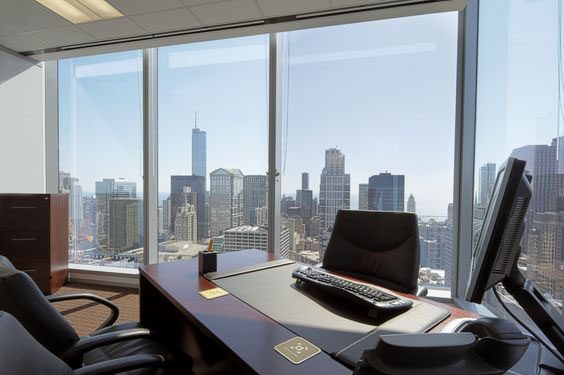
The legal industry continues to favor in-person work after the pandemic, and there is a growing sense of stability among law firm leaders that provides the confidence to invest in office space. This article will go deeper into one of the reasons why Amata clients continue to invest in office space – especially in downtown Chicago.

The Strategic Advantages of Downtown Chicago Office Spaces

Making strategic decisions about your office space can massively impact cash flow, talent attraction, and growth opportunities. Here are some of the reasons why Downtown Chicago emerges as an attractive choice with tangible value:

1. Economic Impact

Downtown Chicago serves as a major hub in the city’s economic landscape. According to a recent study, the central business district generates over $600 million annually in direct spending, and this economic activity can translate into increased opportunities for your firm, exposing you to more business and high-profile clientele.

2. Proximity to Legal Resources

Downtown Chicago is home to legal institutions like Courts, the City Clerk, and the Sheriff’s Offices. 60% of the city’s legal offices are also concentrated in this area. This creates a rich legal ecosystem, making it easier for small law firms to find talent and access court facilities and government offices.

3. Networking Opportunities

A study by the Chicago Chamber of Commerce found that over 80% of professional networking events in the city are hosted in the downtown area. For small law firm owners, an office in downtown is a centralized location to connect and do business, which facilitates valuable encounters with other legal professionals, potential clients, and business partners.

4. Cultural Amenities

The impact of cultural amenities on talent attraction is quantifiable. According to a survey by the National Association for Law Placement (NALP), 75% of legal professionals consider cultural amenities an essential factor when evaluating potential employers. Downtown Chicago’s vibrant cultural scene, with industry events and seasonal festivals like the Christkindlmarket (which attracts more than 1 million visitors each year), become another reason for small law firms to choose this location for office space.

5. Client Impressions

A recent survey conducted by Forbes Insights found that 75% of business executives believe a prestigious office location positively influences their perception of a company. An address in downtown Chicago not only impresses clients but also instills confidence and can potentially influence their hiring decisions.

6. Access to Top Talent

Chicago’s legal talent pool is vast and diverse. According to the American Bar Association (ABA), the city hosts over 45,000 active attorneys. Positioning your law firm in downtown Chicago attracts ambitious and highly driven professionals, with statistics showing that 65% of legal professionals prefer working in central locations for career opportunities and professional growth.

7. Convenient Transportation

Over 70% of the city’s transit lines converge in the central business district, making downtown Chicago a transportation hub. This means it will be easier for employees, clients, and partners to reach your office via public transportation (and spend less time in traffic!).

8. Brand Visibility

A study by the International Downtown Association found that businesses located in central districts experienced a 20% increase in foot traffic and a 15% boost in brand recognition. For small law firms seeking greater brand visibility, the impact of choosing a downtown location is quantifiable.

From economic impact to networking opportunities and talent attraction, choosing a downtown office can provide solo practitioners and small firm owners tangible benefits that impact their bottom line. And if you seek a more prestigious position in the competitive legal landscape of Chicago, this should be one of your top choices.

The question is, how can you access an office in downtown Chicago without being a big law firm yet? That is where our flexible and scalable office plans come in. Contact our team and we will tell you all about them.

Discover our offices for lawyers in Chicago.