
A few years ago I sat in on a conversation between two attorneys at one of our locations — both solos, both about five years in, comparing notes on staffing the way people compare notes on contractors.
One of them said she'd hired a legal assistant. The other said he'd hired a paralegal. They spent about ten minutes describing what their person did, and by the end of it, it was obvious to everyone at the table except the two of them that they had hired essentially the same role and were paying meaningfully different rates for it.
Neither of them was wrong, exactly. That's the strange part. The titles genuinely overlap, firms use them inconsistently, and Illinois — like most states — does not license or certify paralegals, so there's no bright regulatory line to point at. The result is that two attorneys can use the same word to mean two different jobs, and a third can use a different word to mean the same one.
Which sounds like a semantic problem until it costs you money. Then it's a business problem.
In full disclosure: Amata staffs all of these roles, and has since 2002. So I have a stake in you understanding the difference. But the direction of my bias might not be what you'd assume — the most common mistake I see is attorneys paying paralegal rates for work a legal secretary should be doing, and that mistake costs a firm more than it earns us.
Here's the actual breakdown.
What is a paralegal?
A paralegal performs substantive legal work under the supervision of a licensed attorney — drafting pleadings and discovery, conducting legal research, reviewing and summarizing documents, managing case files, and preparing for trial. Paralegal work is billable to clients because it is legal work, not administrative work. It is not, however, the practice of law.
That last sentence is the whole role. A paralegal can draft the motion; only the attorney can decide whether to file it. A paralegal can research the standard; only the attorney can advise the client on what it means for them.
The billability point is worth dwelling on, because it's where most of the economic value sits and where attorneys most often leave money on the table. In Missouri v. Jenkins (491 U.S. 274, 1989), the U.S. Supreme Court held that in statutory fee-award cases, paralegal time is compensable at prevailing market rates rather than at the employer's cost. The reasoning has shaped how courts and clients treat paralegal billing ever since: substantive legal work delegated to a qualified non-lawyer is legitimately billable.
So when a paralegal drafts your discovery responses, that time can generally appear on a client invoice. When your legal secretary calendars the deposition, it generally cannot. Same office, same day, two very different lines on a bill.
Illinois does not license, certify, or register paralegals — there is no state credential and no exam. Certification exists through voluntary national bodies like NALA and NFPA, and it signals training, but it confers no authority. What actually governs the work is your supervision obligation as the attorney, which is a professional responsibility you cannot delegate to a staffing provider.
What is a legal assistant?
A legal assistant supports a law firm with a blend of administrative and light substantive work — client intake, file organization, correspondence, document assembly and formatting, scheduling, and billing support. In practice the title is used loosely, and at some firms "legal assistant" means what another firm would call a paralegal.
The American Bar Association has historically treated "legal assistant" and "paralegal" as interchangeable, which is a large part of why the market is confused. Many job postings use them synonymously. Many firms do too.
Here's how I'd suggest you handle it, because arguing about the dictionary is a poor use of your afternoon. Ignore the title and ask what the person will actually do. If the role involves drafting, research, and document review, you're hiring paralegal-level work regardless of what the business card says — and you should expect paralegal-level rates and paralegal-level supervision. If the role is intake, scheduling, correspondence, and keeping the files straight, you're hiring administrative support, and you should not be paying a premium for it.
At Amata we price this distinction explicitly rather than leaving it to interpretation: administrative support runs $70 an hour, paralegal support runs $90 an hour. Not because one person is better than the other, but because the work is different and one of them is billable.
What is a legal secretary?
A legal secretary handles the clerical and production side of a law firm — document formatting and production, calendaring and deadline entry, filing, transcription, phone coverage, correspondence, and court filing logistics. The role is administrative by definition and does not include substantive legal work.
The title has fallen somewhat out of fashion, which is a shame, because the function has not. Somebody has to produce the documents, keep the calendar accurate, and get things filed on time. At a lot of small firms that somebody is the attorney, at two in the morning.
The distinction from a legal assistant is genuinely blurry and getting blurrier. Historically the split was that a legal secretary produced documents and a legal assistant managed the client relationship and file. In 2026 most small firms have collapsed the two into one role, and that's usually fine — as long as you're not also expecting substantive legal work out of it.
Paralegal vs. legal assistant: what's the actual difference?
The difference is whether the work requires legal judgment that an attorney must review before it leaves the office. A paralegal drafts pleadings, researches issues, and reviews documents — work that is billable and that requires attorney supervision. A legal assistant handles intake, scheduling, correspondence, and file management — work that is administrative and generally not billable.
Two practical tests I'd offer.
The invoice test. If you couldn't defend the line item to a client or a court, it isn't paralegal work. Calendaring is not billable. Drafting the notice of deposition generally is. If you can't imagine writing it on an invoice, don't pay paralegal rates for it.
The review test. Ask whether the output needs your professional eyes before it goes out. An appointment confirmation doesn't. A discovery response absolutely does. Everything in the second category is paralegal work, and everything in that category is also your professional exposure — which is the part attorneys underweight.
The failure mode runs in both directions and the costs are asymmetric. Paying $90 an hour for calendar management wastes money, and it's the more common error. Handing document review to someone trained for administrative work is rarer but much worse: you'll spend attorney hours fixing it, and you've put work product at risk in a way that implicates your own obligations rather than the vendor's.
Legal secretary vs. paralegal: what's the difference?
A legal secretary produces and processes documents; a paralegal produces legal work product. The secretary formats the brief, files it, and calendars the response deadline. The paralegal researched the argument and drafted the first version. One role is production, the other is substance.
This comparison is cleaner than paralegal-versus-legal-assistant because the titles have drifted less. If someone's day is document production, calendaring, filing, transcription, and phones, that's a legal secretary function whatever you call it — and it's a genuinely valuable one that many small firms staff too late.
Paralegal vs. lawyer: what a paralegal cannot do
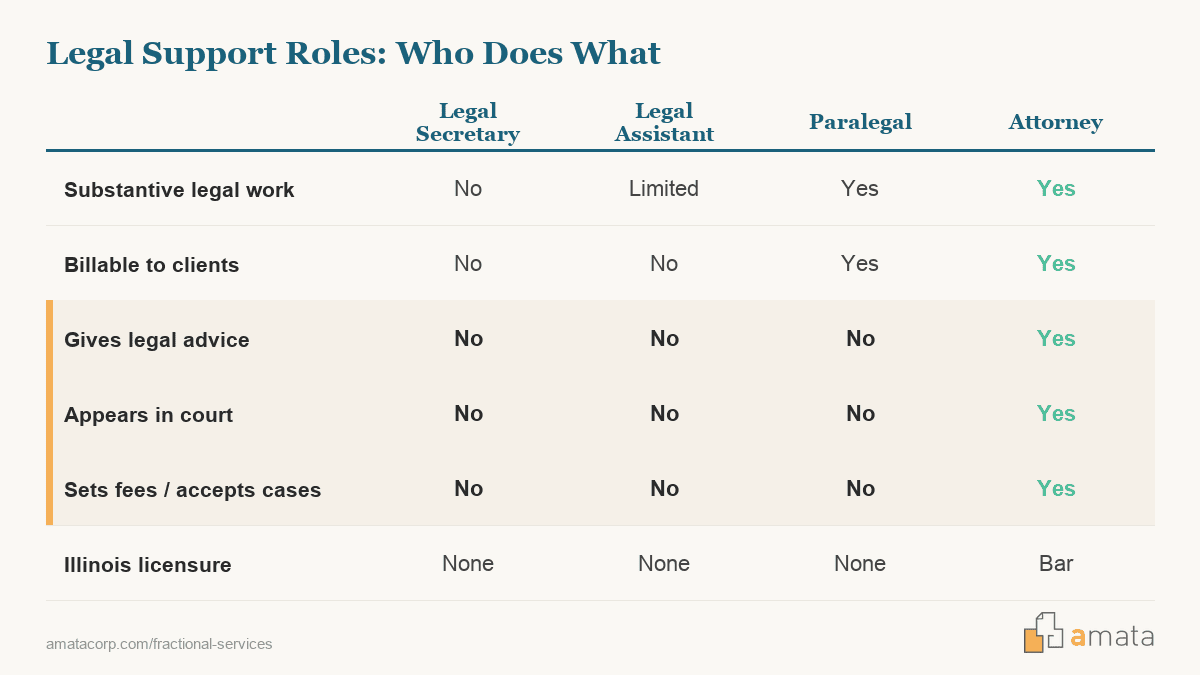
A paralegal cannot practice law. Specifically: no giving legal advice, no representing clients in court or at depositions, no accepting cases, no setting fees, and no signing pleadings. Those five things are reserved to licensed attorneys, and delegating any of them is unauthorized practice of law — with the attorney bearing responsibility.
This is the highest-volume version of this question that people search, and it usually comes from one of two places. Sometimes it's a client wondering whether they can hire a paralegal instead of a lawyer to save money. Sometimes it's an attorney working out how much they can safely delegate.
For the client version: no. A paralegal cannot represent you, cannot advise you on your rights, and cannot take your case. Independent paralegals who offer document preparation directly to the public occupy genuinely contested legal territory that varies by state, and in Illinois the safe answer is that legal advice requires a licensed attorney. The ARDC is the body that enforces this.
For the attorney version: you can delegate a great deal, and most firms delegate too little. A paralegal can run discovery, draft nearly everything, manage the file, prepare exhibits, and handle client communication that doesn't cross into advice. What you cannot delegate is judgment, and what you cannot delegate is the responsibility for supervision — under ABA Model Rule 5.3, adopted in substance in Illinois, you are responsible for the conduct of the non-lawyers working on your matters.
That rule is also the honest answer to the question attorneys are usually really asking, which is whether outsourcing creates risk. It creates a supervision obligation. That obligation is manageable with work logs, matter-level reporting, and a person you can actually reach — but it does not transfer to a vendor, and any provider who implies otherwise is telling you something untrue.
Law clerk vs. paralegal
A law clerk is typically a law student or recent graduate doing research and writing under attorney supervision, usually temporarily and often as part of their training. A paralegal is a career professional whose role is ongoing. The work overlaps substantially — both research, both draft — but the trajectory and the permanence differ.
In Illinois, law students can perform certain supervised functions under Illinois Supreme Court Rule 711, which is a genuinely different authority than anything available to a paralegal. If you're weighing the two: a law clerk brings current legal research training and leaves in a year. A paralegal brings institutional knowledge of your practice and stays. For most small firms the paralegal is the better investment, because the compounding value is in someone who knows how your cases actually run.
The comparison, side by side
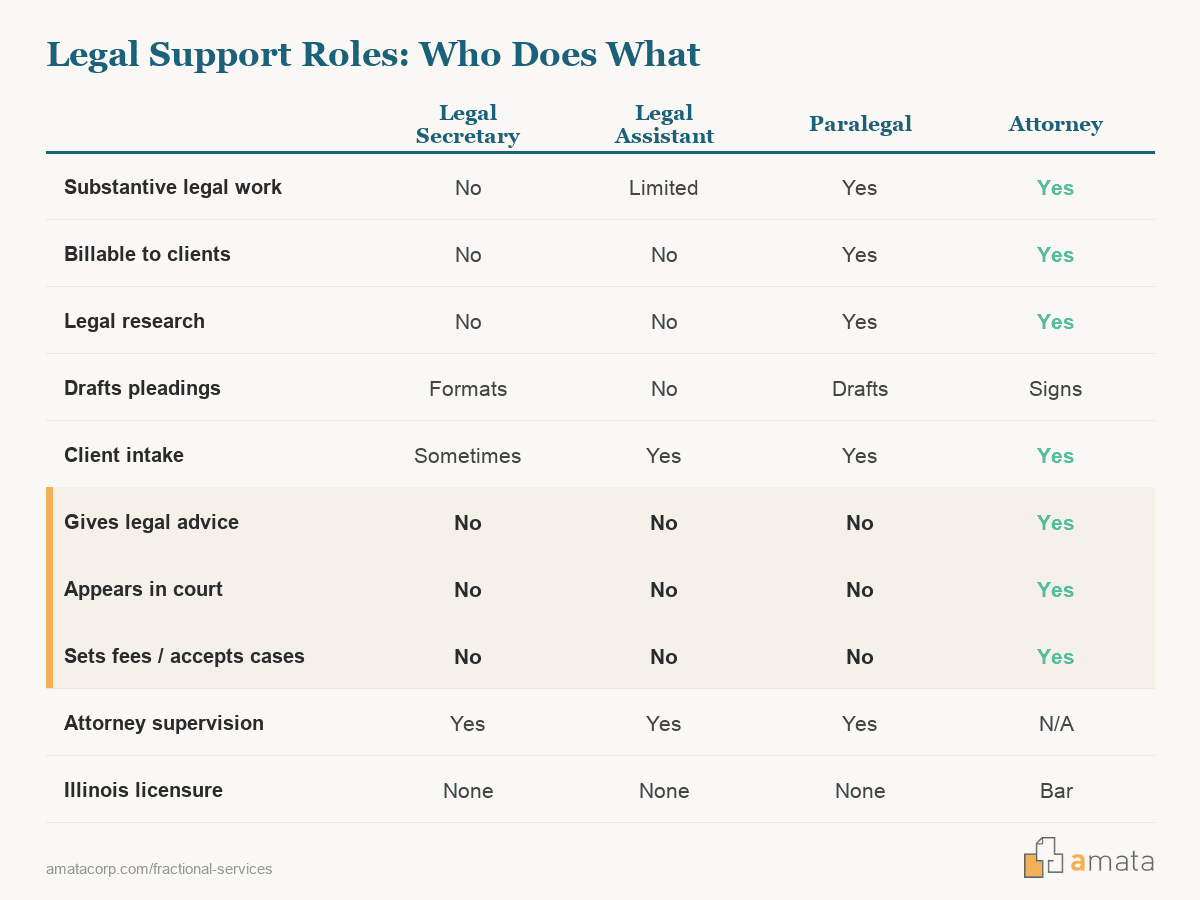
| Legal secretary | Legal assistant | Paralegal | Attorney | |
|---|---|---|---|---|
| Substantive legal work | No | Limited | Yes | Yes |
| Billable to clients | Generally no | Generally no | Yes | Yes |
| Legal research | No | No | Yes | Yes |
| Drafts pleadings | Formats them | No | Drafts them | Signs them |
| Client intake | Sometimes | Yes | Yes | Yes |
| Gives legal advice | No | No | No | Yes |
| Appears in court | No | No | No | Yes |
| Sets fees / accepts cases | No | No | No | Yes |
| Requires attorney supervision | Yes | Yes | Yes | N/A |
| Illinois licensure | None | None | None | Illinois bar admission |
| Typical Amata rate | $70/hr | $70/hr | $90/hr | — |
The three bolded cells in the paralegal column are the ones that matter legally. Everything else is a question of economics and fit. Those three are a question of professional responsibility.
Which role does your firm actually need?
Most small firms need administrative support first and paralegal support second — in that order — and hire them in the reverse order. The instinct is to hire for the legal work because that feels closest to the practice. But the hours that disappear first are usually intake, scheduling, filing, and follow-up.
Try this before you hire anything. Write down every task you personally did last week that someone else could have done. Then sort the list into two columns: work that needed your legal judgment and work that didn't. Total the hours in the second column and multiply by your billing rate.
Two things usually happen. The number is larger than expected. And the second column is overwhelmingly administrative, not substantive — which tells you what to hire.
If the substantive column is the fat one, you need paralegal support. If it's the administrative column, you need administrative support or, at a more senior level, executive assistant support. Most firms need some of both, which is why we don't make people choose one and sign a year for it.
And if you can genuinely fill forty hours a week, every week, hire someone full-time. A fully utilized employee is the better economic answer, and anybody who tells you otherwise is arguing against arithmetic. Fractional staffing exists because most solo and small firms cannot fill those hours — not because full-time employment is a bad idea.
Frequently asked questions
A paralegal performs substantive legal work under attorney supervision — drafting, research, document review — and that time is billable to clients. A legal assistant handles administrative work: intake, scheduling, correspondence, and file management. The titles are often used interchangeably, so evaluate the actual duties rather than the job title.
No. A legal secretary handles document production, calendaring, filing, transcription, and phone coverage — administrative and clerical work. A paralegal produces legal work product: drafts pleadings, conducts research, reviews documents. The secretary formats and files the brief; the paralegal drafted it. Only paralegal time is generally billable to clients.
No. Giving legal advice is the practice of law and is reserved to licensed attorneys. A paralegal also cannot represent clients in court, accept cases, set fees, or sign pleadings. Delegating any of those constitutes unauthorized practice of law, and the supervising attorney bears the professional responsibility.
Not for legal representation or advice. A paralegal cannot advise you on your rights, appear in court on your behalf, or take your case. Independent document-preparation services exist in contested legal territory that varies by state. In Illinois, legal advice requires a licensed attorney in good standing.
Generally yes, when the work is substantive legal work rather than administrative. In Missouri v. Jenkins (1989), the U.S. Supreme Court held that paralegal time is compensable at prevailing market rates in statutory fee-award cases. Administrative time — calendaring, filing, phones — is generally not billable.
No. Illinois does not license, certify, or register paralegals, and there is no state exam. Voluntary national certifications through NALA and NFPA signal training but confer no authority to practice. What governs the work is the supervising attorney's professional responsibility, which cannot be delegated to a vendor.
A law clerk is usually a law student or recent graduate doing supervised research and writing, typically temporarily as part of their training. A paralegal is a career professional in an ongoing role. The work overlaps, but in Illinois, law students may perform certain functions under Supreme Court Rule 711 that paralegals cannot.
A licensed attorney in good standing. Under ABA Model Rule 5.3, adopted in substance in Illinois, an attorney is responsible for the conduct of non-lawyer assistants working on their matters. That obligation applies equally to in-house staff and outsourced providers, and it does not transfer to the vendor.
Usually administrative support. The hours that disappear first for most solos are intake, scheduling, filing, and follow-up rather than substantive legal work. List every task you did last week that someone else could have done, sort by whether it needed legal judgment, and hire against whichever column is larger.
Amata's published rates are $70 an hour for administrative support and $90 an hour for paralegal support, billed in sixth-of-an-hour increments. Monthly programs run $980 for twenty administrative hours, $1,650 for thirty executive assistant hours, and $2,520 for forty paralegal hours, with 32% off hourly rates.
The part that actually matters
Twenty-four years in, having supported more than 1,800 firms — roughly 800 attorneys and professionals are in our community right now — I've stopped believing that the title question is the interesting one.
What's interesting is that most attorneys carry an enormous amount of work that somebody else could do, and they carry it because sorting out who should do what feels like one more project on a list that's already too long. So they keep doing it themselves, and the hours go somewhere, and the practice grows slower than it should.
You don't need to solve the taxonomy. You need to write down what you did last week and be honest about which parts required a law degree.
Talk it through with us: 312.924.0200 or [email protected]. We'll tell you which role you actually need, including when the answer is one we don't sell.