
Offshore Legal Staffing: What the Ethics Rules Actually Require

Every attorney who asks me about offshore support asks the same three questions, usually in the same order.

Is it allowed. Who's responsible if something goes wrong. And do I have to tell my client.

Those are the right questions, and it's striking how hard it is to get straight answers to them. Search the term and you'll find a dozen providers explaining how much you'll save. Almost none of them mention that the American Bar Association addressed this in 2008, that Illinois has its own opinion on it, or that in Illinois you probably owe your client a conversation before you start.

In full disclosure: Amata's staffing model includes employees in Colombia and the Philippines alongside our Chicago team, so we sell this. Which is exactly why I'd rather write the version that tells you what your obligations are than the version that tells you what you'll save. If you engage anyone for offshore support — us or somebody else — and you haven't handled the items below, the exposure is yours, not the vendor's.

One note before we start: this is general information, not legal advice. Ethics rules are jurisdiction-specific, the opinions below are advisory rather than binding, and your own bar's requirements govern. Confirm anything that matters with ethics counsel.

What is offshore legal staffing?

Offshore legal staffing is the use of legal support personnel located outside the United States — paralegals, legal administrative staff, document reviewers — working on a U.S. law firm's matters under the supervision of a licensed attorney at that firm. It is a delivery model, not a category of legal service.

The distinction that matters throughout: these are support staff performing work under supervision. They are not practicing law, and describing them otherwise creates a problem that has nothing to do with geography.

The market is substantial. Estimates for global legal process outsourcing run between roughly $20 billion and $30 billion for 2024–2025 depending on which research house you ask, with offshore delivery accounting for somewhere near 77 to 79 percent of it. Thomson Reuters' 2025 Legal Department Operations Index found 43% of chief legal officers planning to send more work outside their organizations — seventeen percentage points above the prior year.

So this is no longer novel. Large firms and corporate legal departments have done it at scale for two decades. What changed recently is that it became viable for small firms.

Is offshore legal support ethical?

Yes, with conditions. ABA Formal Opinion 08-451 states that a lawyer may outsource legal and nonlegal support services, domestically or overseas, provided the lawyer remains ultimately responsible for delivering competent representation to the client. Every state authority to address it since has reached the same conclusion.

That opinion, issued in August 2008, is the foundational document. Its requirements, in plain terms:

Competence stays with you. Under Model Rule 1.1, you remain responsible for the quality of the representation regardless of who performed which task.

Supervision stays with you. Rules 5.1 and 5.3 require reasonable efforts to ensure the provider's conduct is compatible with your own professional obligations.

Disclosure and consent. The opinion says appropriate disclosure should be made about the use of outside lawyers and nonlawyers, and consent obtained where they will receive information protected by Rule 1.6.

Conflicts screening. The provider must not be working for adversaries on the same or substantially related matters.

Reasonable fees under Rule 1.5.

No assisting unauthorized practice under Rule 5.5.

The opinion also acknowledges directly that overseas arrangements make supervision harder — distance, time zones, differing legal systems — and recommends reference and background checks on the provider.

Several state and local bars addressed overseas outsourcing specifically, and the pattern is consistent: permitted, but treated as higher-risk than domestic, warranting clearer consent and tighter access controls. Florida Bar Opinion 07-2, North Carolina 2007 Formal Ethics Opinion 12, and New York City Bar Formal Opinion 2006-3 all land there. Florida's opinion is notable for stating expressly that nothing in it should be read as an endorsement, and for directing lawyers to familiarize themselves with the privacy laws of the offshore jurisdiction.

Do I have to tell my client?

In Illinois, ordinarily yes. ISBA Opinion 19-04 states that when a lawyer outsources legal or legal-support services, including to other countries, "disclosure to, and informed consent by, the client will ordinarily be required." It is always required where a lawyer transfers complete or substantial responsibility for a matter to an unaffiliated lawyer.

This is the question providers skip, and it's the one with real consequences.

That last point comes from Illinois Rule of Professional Conduct 1.2(e), which is unusual — most states don't have an equivalent, and Illinois has had it since 1980. Worth knowing if you practice in more than one jurisdiction, because the Illinois requirement is stricter than the baseline.

North Carolina goes further still, requiring the client's advance informed consent. New York City's opinion requires securing consent before disclosing confidential information to a foreign provider.

What generally drives whether consent is required:

Does the provider receive confidential client information? If yes, Rule 1.6 is engaged and consent moves from advisable to expected.

Is the work substantive or ministerial? Purely administrative support under close supervision is treated more like an in-house assistant. Substantive legal work is not.

How is it billed? Separately billed or marked-up arrangements attract more scrutiny than costs passed through at actual cost.

My practical advice: have the conversation. Attorneys tend to assume clients will object, and in my experience clients mostly want to know that someone competent is doing the work and that their information is protected. A client who finds out later, from someone else, reacts very differently than a client you told up front.

Who supervises the work?

You do. Under ABA Model Rule 5.3 — adopted in substance in Illinois — a lawyer is responsible for the conduct of nonlawyers working on their matters, and that obligation does not transfer to a vendor. No contract term, indemnity, or service agreement changes it.

The 2012 amendments to Rule 5.3 added commentary addressing nonlawyers outside the firm specifically. What the required supervision looks like scales with circumstances: the education, experience and reputation of the nonlawyer; the nature of the work; the terms of any arrangements protecting client information; and the legal and ethical environment of the jurisdiction where the work is performed.

That last factor is the one that makes offshore different from domestic. You're expected to have thought about the enforceability of confidentiality obligations in the provider's country.

And the duty doesn't end at vendor selection. Illinois guidance is explicit that protecting client information requires ongoing monitoring, not a one-time due diligence exercise.

What this means practically. A good provider makes supervision workable — detailed work logs, matter-level reporting, a named person you can reach rather than a support queue. A poor provider stays vague about it and lets you assume the obligation went away. It didn't.

How is confidentiality protected?

Rule 1.6 requires reasonable efforts to prevent unauthorized disclosure of client information, and that obligation applies identically whether the person handling the file sits in Chicago or Bogotá. The safeguards ethics authorities expect are specific and worth asking about directly.

From the opinions across jurisdictions, the expected controls are:

  • Written confidentiality agreements with the provider, with remedies for breach
  • Access limited to only the information needed for that specific matter — and explicitly no access to other clients' files
  • Secure transmission and storage, encryption, access controls, passwords
  • Conflict-check questionnaires
  • Background and reference checks on the provider and any intermediary
  • Documented supervision
  • Attention to the data-protection regime and enforceability environment of the provider's jurisdiction

One structural point that gets missed. Florida's opinion specifically addresses subcontracting chains — the provider you vetted may not be the entity doing the work. Ask directly whether any portion is subcontracted, and to whom.

That isn't hypothetical. The clearest documented offshore confidentiality incident involved a medical transcription chain: in 2003, a Karachi-based transcriptionist at the end of a three-subcontractor chain threatened to post UCSF Medical Center patient files publicly over a pay dispute, and emailed actual files to prove she could. UCSF had not known the work reached overseas at all. It isn't a law firm case, but the failure mode — a chain nobody had mapped — transfers directly.

Can I bill offshore support to my client?

Yes, with a distinction that matters. Under ABA Formal Opinions 93-379 and 00-420, a firm may bill outsourced work as a legal fee and charge a reasonable total including overhead and profit. Pass the same cost through as a disbursement and you may charge only actual cost — unless the engagement letter disclosed a surcharge up front.

Almost nobody writes about this and it's a genuine trap.

The practical rule: if you intend to profit from delegated work, bill it as a fee, with the total reasonable under Rule 1.5. If you bill it as an expense line, bill what it cost you — unless you disclosed a surcharge in the engagement letter and the client agreed to it. Presenting an undisclosed markup as a disbursement is the version that creates a problem.

Employee or contractor: the distinction that matters most

Whether the offshore staff are employees of the provider or independent contractors sourced through a marketplace changes your risk profile more than which country they're in. An employer-of-record model produces enforceable contracts, stable assignment, and accountability. A marketplace produces neither.

This is where I'd focus evaluation, and it's the part rate comparisons obscure entirely.

A marketplace or contractor model refers you to independent workers. They can take other work, leave without notice, and are typically not covered by the platform's insurance. Confidentiality obligations run to individuals you have no relationship with. Turnover is high, which means the institutional knowledge that makes support valuable never accumulates.

A direct-employee or employer-of-record model means the provider legally employs the person in their own country. The employment contract carries confidentiality and intellectual-property terms enforceable there, and that person is assigned to your firm rather than shared. Supervision has somewhere to attach.

Rule 5.3 asks you to weigh the provider's arrangements protecting client information. A marketplace's answer to that question is structurally weaker than an employer's, regardless of price.

Five questions worth asking any provider:

  1. Are the staff your employees, or contractors you refer to me?
  2. Is any part of the work subcontracted, and to whom?
  3. What is your vetting process, in actual steps?
  4. What confidentiality instruments bind them, and are those enforceable in their jurisdiction?
  5. Do you carry professional liability coverage on the people doing my work — in writing?

What actually goes wrong

The documented failures in offshore support trace to unmapped subcontracting chains, undefined task boundaries, and supervision that existed on paper only — not to the location of the worker. The evidence base is thinner than either advocates or critics suggest.

Two incidents are cited repeatedly, and both are worth knowing accurately.

The 2003 UCSF transcription case described above — a subcontracting chain the client institution didn't know existed. And in 2005, employees at a call center in Pune, India stole roughly $350,000 from four Citibank customers by obtaining PINs during support calls; more than a dozen people were arrested.

Neither is a law firm. Both are about controls, not geography.

What I'd want you to weigh honestly: I could not find a U.S. bar discipline case or malpractice judgment squarely attributed to offshore supervision failure, and no case treating properly supervised offshore support as unauthorized practice of law. The one lawsuit that tried to enjoin foreign legal outsourcing was voluntarily withdrawn in 2008.

But absence of reported cases is not evidence that the risk is small. It reflects limited public reporting and the general difficulty of enforcement in this area. I'd rather tell you the record is thin than tell you it's clean.

Independent comparative quality data — offshore versus domestic legal support — essentially doesn't exist in public. Nearly every "quality maintained, costs cut 50 to 70 percent" figure you'll encounter comes from a vendor. Including, to be fair, from vendors like us. Treat all of it as directional.

A note on our own arrangement

I opened by disclosing that we sell this, so it's fair to say plainly what we do.

Our offshore team members in Colombia and the Philippines currently provide executive assistant and administrative support, engaged full-time through employer-of-record partners who serve as the legal employer in-country. Paralegal work, and anything touching privileged client files, is performed by Chicago-based staff. Each offshore team member signs a non-disclosure agreement directly with us before starting.

So the chain runs: client → Amata → employer-of-record partner → the individual. Three links beyond you, each under written agreement.

I'm spelling that out because earlier in this piece I told you to ask every provider for exactly that. It would be a poor article that made the case and then dodged the question. A provider who tells you there's no chain either hasn't looked, or is hoping you won't.

Frequently asked questions

Yes, with conditions. ABA Formal Opinion 08-451 permits outsourcing legal and nonlegal support services domestically or overseas, provided the lawyer remains ultimately responsible for competent representation. Every state authority to address it since has agreed. The conditions concern supervision, confidentiality, conflicts, disclosure, and fees.

In Illinois, ordinarily yes. ISBA Opinion 19-04 states disclosure and informed consent will ordinarily be required when a lawyer outsources legal or legal-support services, including overseas. It is always required where an unaffiliated lawyer assumes substantial responsibility for a matter.

The supervising attorney at the firm. Under ABA Model Rule 5.3, adopted in substance in Illinois, a lawyer is responsible for the conduct of nonlawyers working their matters. That obligation does not transfer to a vendor by contract, indemnity, or service agreement.

Written confidentiality agreements, access limited to only the matter at hand with no access to other clients' files, secure transmission and storage, conflict screening, background checks, documented supervision, and attention to the data-protection and enforceability environment of the provider's jurisdiction.

They can perform substantive legal support work — drafting, research, document review, case management — under attorney supervision. They cannot exercise legal judgment, give legal advice, or perform any act reserved to licensed attorneys, and describing them otherwise raises unauthorized-practice concerns.

It depends on how you bill it. Under ABA Formal Opinions 93-379 and 00-420, work billed as a legal fee may include overhead and profit if the total is reasonable under Rule 1.5. Cost passed through as a disbursement may be billed only at actual cost, absent advance disclosure of a surcharge in the engagement agreement.

A marketplace refers you to independent contractors who can take other work and leave without notice, often outside the platform's insurance. An employer-of-record legally employs the person in-country with enforceable confidentiality terms and assigns them exclusively to one firm, so supervision and accountability have somewhere to attach.

The most cited incidents are a 2003 medical transcription case involving an unmapped subcontracting chain and a 2005 call-center fraud in India. Neither involved a law firm. No U.S. bar discipline case appears squarely attributed to offshore supervision failure, though thin reporting is not proof of low risk.

Not currently. Our offshore team members provide executive assistant and administrative support; paralegal work and anything touching privileged client files is handled by Chicago-based staff. That reflects where the model stands today rather than a permanent limit, and we'd rather say so than imply otherwise.

India pioneered the market and still leads by volume, the Philippines is the fastest-growing Asian provider, and Latin America — Colombia, Mexico, Argentina — is increasingly favored for U.S. time-zone overlap and bilingual capability. Which fits depends less on the country than on the provider's structure and controls.

E-filing can generally be handled remotely. Physical court runs, Clerk's office trips, and courtesy copies to chambers require someone in the building, so those need local staff regardless of provider. Any provider claiming remote coverage of physical courthouse tasks is worth a direct follow-up question.

The version nobody sells you

Twenty-four years in, having supported more than 1,800 firms, I've come to think the offshore conversation gets framed backwards.

It's usually presented as a cost decision with an ethics footnote. It's actually an ethics decision with a cost benefit — and the firms that treat it the second way get better outcomes, because they ask harder questions before signing and end up with providers who can answer them.

The rules aren't obstacles here. They're a checklist. Written confidentiality terms, matter-scoped access, no unmapped subcontractors, documented supervision, a conversation with your client. A provider who can satisfy all five is a provider worth having. One who can't is going to be cheaper, and you'll find out why.

Ask these questions of whoever you're evaluating. If you want to test them on us first, we're at 312.924.0200 or [email protected] — and if the answers don't satisfy you, don't buy.

Ron Bockstahler is the founder and CEO of Amata Law Office Suites, a vendor member of the Chicago Bar Association, supporting Chicago-area law firms since 2002. He co-hosts The 1958 Lawyer podcast.

Amata Law Office Suites is not a law firm and does not provide legal services to the general public. All legal support services are performed under the supervision of a licensed attorney in good standing. This article is general information about professional responsibility rules, not legal advice. Ethics requirements vary by jurisdiction, the opinions discussed are advisory rather than binding, and your own state's Rules of Professional Conduct govern. Confirm your obligations with ethics counsel.

Sources: ABA Formal Opinion 08-451 on outsourcing legal and nonlegal support services. ABA Model Rule 5.3 on nonlawyer assistance. ISBA Opinion 19-04 on outsourcing legal and legal support services. Florida Bar Opinion 07-2, North Carolina 2007 FEO 12, and New York City Bar Formal Opinion 2006-3 on overseas outsourcing. ABA Formal Opinions 93-379 and 00-420 on billing for outsourced work. Illinois ARDC on attorney registration and discipline. Market sizing figures are third-party research estimates and vary by source.

What Does a Virtual Paralegal Cost? Real Numbers, Including Ours

A few years back I sat across from an attorney who had just done the math on his first paralegal hire and decided he couldn't afford one.

His reasoning was sound as far as it went. Seventy thousand in salary. Payroll taxes on top. Health insurance. A desk, a chair, a monitor, a license for whatever practice management software he'd end up buying. He'd penciled it out somewhere north of ninety thousand and concluded the practice wasn't ready.

What he hadn't priced was the other side of the ledger — the twelve hours a week he was spending on work a paralegal would have done. At his rate, those twelve hours were worth more than the paralegal cost. He wasn't saving ninety thousand a year. He was spending considerably more than that and not seeing it, because unbilled time doesn't show up on a bank statement.

That conversation is why I publish our rates instead of putting them behind a discovery call.

In full disclosure: Amata sells paralegal support, so read the numbers below with that in mind. But I'd rather you run the math honestly and decide we're wrong for you than have you make the same mistake he did.

What does a virtual paralegal cost?

Virtual paralegal services typically cost $60 to $125 per hour depending on experience and supervision, or $1,500 to $4,000 per month on a set-hours program. Amata's published rate is $90 an hour for paralegal support, billed in sixth-of-an-hour increments, or $2,520 a month for forty hours through Paralegal-40.

That range is wide for a reason, and the spread is mostly about what you're actually buying. At the bottom you're often getting a contractor from a marketplace, unsupervised, uninsured, and available until someone offers them more. At the top you're getting an employee of a firm that vets, trains, insures, and backs them up.

Neither is wrong. But comparing the two on hourly rate alone is like comparing two cars on curb weight.

What are Amata's actual rates?

Amata publishes $90 an hour for paralegal support and $70 an hour for administrative support, both billed in sixth-of-an-hour increments. Monthly programs run $980 for twenty administrative hours, $1,650 for thirty executive assistant hours, and $2,520 for forty paralegal hours. Enrolling in a program takes 32% off hourly rates.

ProgramHours/monthMonthly
Admin-2020$980
EA-3030$1,650
Paralegal-4040$2,520
Admin-20 & Marketing Lab Plus20 admin + 8.5 marketing$1,595
CustomFlexibleQuote

A few things the table doesn't say.

Hours don't roll over month to month. If you buy forty and use thirty, the ten are gone. That's deliberate — rollover encourages firms to underuse the service and then dump a backlog in December, which serves nobody. Overages bill at your plan's rate.

E-filing is paralegal work and bills at the paralegal rate, not the admin rate. Some providers quietly bill it as administrative because it looks clerical. It isn't — a rejected filing is a legal problem, not a clerical one.

Cancellation takes one calendar month's written notice. No annual commitment, no early termination penalty.

Stay away from any provider who won't give you a number before a sales conversation. If the price depends on what they think you can pay, that's what the call is for.

How does that compare to hiring a full-time paralegal?

A full-time paralegal in Chicago runs about $94,750 fully loaded — Amata’s own most recent hire: $65,000 salary at four to five years’ experience, a bonus worth about $10,800, and 25% for taxes and benefits — before desk, computer, and phone. Forty hours a month of fractional paralegal support runs $30,240 a year.

The comparison isn't apples to apples, and I won't pretend it is. A full-time paralegal gives you 173 hours a month, not 40. If you can genuinely fill 173 hours with substantive legal work, every month, the full-time hire is the better economic answer and anyone telling you otherwise is arguing against arithmetic.

The question is whether you can. Most solo and small firms can't, and they hire full-time anyway because it's the only model they know. Then they carry the salary through the slow months.

Two costs that don't appear in the salary line and should:

Turnover. SHRM puts replacement cost at 50% to 200% of annual salary once you count recruiting, lost productivity, and ramp time. On a $70,000 paralegal that's $35,000 to $140,000 the first time it happens.

The vacancy. The average paralegal opening takes around eight weeks to fill. Eight weeks during which the work lands back on your desk — while you're also interviewing.

What is your own time actually worth?

Multiply your billable rate by the hours you spend weekly on work a paralegal could do. That number is your real budget, and it is almost always larger than the cost of the support. Clio puts the average lawyer's billable rate at $349 an hour, with solo practitioners capturing about 2.9 billable hours of an eight-hour day — roughly 37%.

Here's the arithmetic that convinced me to build this business.

Say you spend eight hours a week on discovery organization, document assembly, and file management. That's about 35 hours a month. At $349, those hours represent roughly $12,200 in unbilled capacity every month.

You will not recover all of it. Nobody recovers all of it — you'll spend some of the freed time on things that don't bill either, and some weeks the work simply isn't there. But at Paralegal-40's $2,520, you need to convert about 7 of those 35 hours into billable work to break even. Twenty percent.

That's the actual hurdle. Not "can I afford $2,520," but "can I bill seven more hours a month if someone takes 35 hours of non-legal work off my desk."

Capturing 37% of the day isn’t a talent problem — nobody thinks solo practitioners work less than anyone else. It’s an infrastructure gap, and infrastructure is purchasable.

What about a staffing agency?

Traditional legal staffing agencies charge an hourly markup on temporary placements, plus a separate conversion fee when a temporary placement becomes your permanent employee. The model works well for firms filling a full-time seat and poorly for firms that need twenty-five hours a week.

Two structural differences matter more than the rate.

The person an agency sends is between assignments rather than assigned to you. That means the institutional knowledge that makes a paralegal valuable in month six never accumulates anywhere — you get competence without context, permanently.

And the conversion fee is real. If you decide you want to keep the person, there's a cost to that. I'll be straight that this is true of us too — Amata charges a conversion fee if you hire your assigned staff member as your own full-time employee, and the terms depend on the role and tenure. We just don't publish a number for it, because it varies. Ask, and we'll tell you.

What we don't do is require you to fill forty hours a week to work with us. Twenty a month is the floor.

For the broader outsourcing decision — what providers should be able to answer, and why engagements fail — see our full guide to outsourced paralegal services.

What about offshore paralegal support?

Offshore legal support is common and expressly permitted — the ABA addressed it in Formal Opinion 08-451, the Illinois State Bar in Opinion 19-04 — and it costs materially less than US-based staff. What it does not do is remove your supervision obligation or, in most cases, your duty to tell your client.

This is the biggest cost variable in the market and it would be strange for a page about pricing not to address it.

The economics are real. Offshore legal support generally runs a fraction of US-based rates, which is why the model exists and why adoption has grown quickly. In full disclosure, Amata's staffing model includes employees in Colombia and the Philippines alongside our Chicago team, so we participate in this.

Three things I'd want you to know before you price it.

You still supervise it. Under ABA Model Rule 5.3 and its Illinois counterpart, you are responsible for the conduct of non-lawyers working your matters, wherever they sit. Distance and time zones make that harder, not optional. Any provider implying you can hand off responsibility is describing something that doesn't exist.

You probably owe your client a conversation. ISBA Opinion 19-04 states that when an Illinois lawyer outsources legal or legal-support services, including overseas, disclosure to and informed consent by the client will ordinarily be required — and it is always required where an unaffiliated lawyer takes substantial responsibility for a matter. That's a real obligation, not a formality, and it's the part most cost comparisons skip entirely.

Employee or contractor matters more than country. A provider that legally employs its offshore staff — with enforceable confidentiality agreements, matter-scoped access, background checks, and professional liability coverage — is a different product from a marketplace that refers you to freelancers. The first maps onto your supervision duty. The second leaves you assembling it yourself.

Why we don't publish an offshore rate. Because it varies genuinely by experience level and scope, and a headline number would imply a commodity service. Ask us and we'll quote your engagement. But I'd rather have that conversation than post a figure that makes offshore look like a vending machine.

There's more to say about confidentiality, quality control, and how the ethics rules actually apply in practice than belongs on a pricing page. That piece now exists: offshore legal staffing and what the ethics rules actually require.

What should a small firm actually budget?

Most solo and small firms land between $980 and $2,520 a month. Which end depends on whether the work crushing you is substantive or administrative. For most firms it's administrative, which means the cheaper program is usually the right first purchase rather than the more expensive one.

Try this before you buy anything from anyone. Write down every task you personally did last week that someone else could have done. Sort it into two columns: work that needed your legal judgment, and work that didn't. Total the hours in the second column and multiply by your rate.

Two things usually happen. The total is bigger than you expected. And the second column is overwhelmingly administrative rather than substantive — intake, scheduling, filing, follow-up — which tells you that administrative support at $980 is probably the right first purchase, not paralegal support at $2,520.

That's the opposite of what most firms buy first. They hire for the legal work because it feels closest to the practice. The hours that actually disappear are the other kind.

If the substantive column is the heavy one, paralegal support is where to start. If you need senior-level calendar, inbox, and client coordination, that's executive assistant support.

Frequently asked questions

Virtual paralegal rates typically run $60 to $125 an hour depending on experience, supervision, and whether the provider employs or contracts the person. Amata publishes $90 an hour for paralegal support, billed in sixth-of-an-hour increments, with 32% off for firms enrolled in a monthly program.

Amata charges $90 an hour for paralegal support and $70 an hour for administrative support, billed in sixth-of-an-hour increments. Monthly programs are $980 for twenty administrative hours, $1,650 for thirty executive assistant hours, and $2,520 for forty paralegal hours. Program enrollment takes 32% off hourly rates.

It depends entirely on whether you can fill forty hours a week. A fully loaded full-time paralegal runs about $94,750 a year — Amata’s own most recent Chicago hire; forty monthly hours of fractional support runs $30,240. If you can genuinely keep a full-time person busy, full-time is the better economic answer.

Amata’s most recent full-time Chicago hire came to about $94,750 annually once salary, bonus, payroll taxes, and benefits are included — before desk, computer, and phone. Fractional and virtual arrangements start considerably lower because you pay for hours used rather than a full-time seat.

No. Hours do not carry into the following month. That's deliberate — rollover encourages firms to underuse support and then dump a backlog at year end, which serves nobody well. Overages are invoiced at your plan's hourly rate rather than a penalty rate.

The minimum is twenty hours a month. There is no annual contract and no early termination penalty, and cancellation requires one calendar month's written notice. Firms routinely scale hours up during trial preparation and back down once a matter settles, which is the point of the model.

E-filing is paralegal work and bills at the paralegal rate of $90 an hour. Some providers bill it administratively because the task looks clerical, but a rejected filing is a legal problem rather than a clerical one and it requires someone who understands the consequences.

Firms that outgrow fractional hours sometimes want to bring their assigned person in-house, and Amata accommodates that. A conversion fee applies and terms depend on the role and how long the person has been with the firm. Ask for specifics rather than assuming a figure.

Generally yes — offshore legal support costs a fraction of US-based rates, which is why adoption has grown. Amata does not publish an offshore rate because it varies by experience level and scope. The cost difference does not reduce your supervision obligation or any client disclosure duty.

Ordinarily yes, in Illinois. ISBA Opinion 19-04 states that disclosure to and informed consent by the client will ordinarily be required when a lawyer outsources legal or legal-support services, including overseas, and is always required where an unaffiliated lawyer assumes substantial responsibility.

Multiply your billable rate by the hours weekly you spend on non-legal work. At Clio's reported $349 average billable rate, eight hours a week of administrative work represents roughly $12,200 monthly in unbilled capacity. Most firms find that figure exceeds the cost of the support entirely.

Faster than hiring, because there is no recruiting or onboarding cycle. Amata staff are already vetted and trained and are oriented to your practice as they begin. Compare that to an average paralegal vacancy of roughly eight weeks, during which the work returns to the attorney's desk.

What the number actually buys

Twenty-four years in, having supported more than 1,800 firms, I've stopped believing the price question is the interesting one.

The interesting question is what an attorney does with the hours. Some firms buy twenty hours a month, hand over intake, and bill four more hours a week within a quarter. Others buy the same twenty hours, never quite let go of the work, and cancel in month five wondering what happened.

The difference isn't the budget. It's whether you actually stop doing the work once someone else is doing it.

So before you compare rates, answer the harder question: if thirty-five hours of non-legal work disappeared from your desk next month, what would you do with them? If you have a real answer, the arithmetic almost always works. If you don't, no provider at any price is going to fix that.

Talk it through with us: 312.924.0200 or [email protected]. We'll tell you honestly if what you need costs less than what we sell.

Ron Bockstahler is the founder and CEO of Amata Law Office Suites, a vendor member of the Chicago Bar Association, supporting Chicago-area law firms since 2002. He co-hosts The 1958 Lawyer podcast.

Amata Law Office Suites is not a law firm and does not provide legal services to the general public. All legal support services are performed under the supervision of a licensed attorney in good standing. Pricing current as of August 2026 and subject to change.

Sources: Clio Legal Trends Report for billable rate and utilization figures. SHRM for employee replacement cost. Fully loaded staffing cost is an Amata estimate for the Illinois market consistent with BLS and regional salary data; individual firm results vary.

Paralegal vs. Legal Assistant vs. Legal Secretary: What Each Role Actually Does

A few years ago I sat in on a conversation between two attorneys at one of our locations — both solos, both about five years in, comparing notes on staffing the way people compare notes on contractors.

One of them said she'd hired a legal assistant. The other said he'd hired a paralegal. They spent about ten minutes describing what their person did, and by the end of it, it was obvious to everyone at the table except the two of them that they had hired essentially the same role and were paying meaningfully different rates for it.

Neither of them was wrong, exactly. That's the strange part. The titles genuinely overlap, firms use them inconsistently, and Illinois — like most states — does not license or certify paralegals, so there's no bright regulatory line to point at. The result is that two attorneys can use the same word to mean two different jobs, and a third can use a different word to mean the same one.

Which sounds like a semantic problem until it costs you money. Then it's a business problem.

In full disclosure: Amata staffs all of these roles, and has since 2002. So I have a stake in you understanding the difference. But the direction of my bias might not be what you'd assume — the most common mistake I see is attorneys paying paralegal rates for work a legal secretary should be doing, and that mistake costs a firm more than it earns us.

Here's the actual breakdown.

What is a paralegal?

A paralegal performs substantive legal work under the supervision of a licensed attorney — drafting pleadings and discovery, conducting legal research, reviewing and summarizing documents, managing case files, and preparing for trial. Paralegal work is billable to clients because it is legal work, not administrative work. It is not, however, the practice of law.

That last sentence is the whole role. A paralegal can draft the motion; only the attorney can decide whether to file it. A paralegal can research the standard; only the attorney can advise the client on what it means for them.

The billability point is worth dwelling on, because it's where most of the economic value sits and where attorneys most often leave money on the table. In Missouri v. Jenkins (491 U.S. 274, 1989), the U.S. Supreme Court held that in statutory fee-award cases, paralegal time is compensable at prevailing market rates rather than at the employer's cost. The reasoning has shaped how courts and clients treat paralegal billing ever since: substantive legal work delegated to a qualified non-lawyer is legitimately billable.

So when a paralegal drafts your discovery responses, that time can generally appear on a client invoice. When your legal secretary calendars the deposition, it generally cannot. Same office, same day, two very different lines on a bill.

Illinois does not license, certify, or register paralegals — there is no state credential and no exam. Certification exists through voluntary national bodies like NALA and NFPA, and it signals training, but it confers no authority. What actually governs the work is your supervision obligation as the attorney, which is a professional responsibility you cannot delegate to a staffing provider.

What is a legal assistant?

A legal assistant supports a law firm with a blend of administrative and light substantive work — client intake, file organization, correspondence, document assembly and formatting, scheduling, and billing support. In practice the title is used loosely, and at some firms "legal assistant" means what another firm would call a paralegal.

The American Bar Association has historically treated "legal assistant" and "paralegal" as interchangeable, which is a large part of why the market is confused. Many job postings use them synonymously. Many firms do too.

Here's how I'd suggest you handle it, because arguing about the dictionary is a poor use of your afternoon. Ignore the title and ask what the person will actually do. If the role involves drafting, research, and document review, you're hiring paralegal-level work regardless of what the business card says — and you should expect paralegal-level rates and paralegal-level supervision. If the role is intake, scheduling, correspondence, and keeping the files straight, you're hiring administrative support, and you should not be paying a premium for it.

At Amata we price this distinction explicitly rather than leaving it to interpretation: administrative support runs $70 an hour, paralegal support runs $90 an hour. Not because one person is better than the other, but because the work is different and one of them is billable.

What is a legal secretary?

A legal secretary handles the clerical and production side of a law firm — document formatting and production, calendaring and deadline entry, filing, transcription, phone coverage, correspondence, and court filing logistics. The role is administrative by definition and does not include substantive legal work.

The title has fallen somewhat out of fashion, which is a shame, because the function has not. Somebody has to produce the documents, keep the calendar accurate, and get things filed on time. At a lot of small firms that somebody is the attorney, at two in the morning.

The distinction from a legal assistant is genuinely blurry and getting blurrier. Historically the split was that a legal secretary produced documents and a legal assistant managed the client relationship and file. In 2026 most small firms have collapsed the two into one role, and that's usually fine — as long as you're not also expecting substantive legal work out of it.

Paralegal vs. legal assistant: what's the actual difference?

The difference is whether the work requires legal judgment that an attorney must review before it leaves the office. A paralegal drafts pleadings, researches issues, and reviews documents — work that is billable and that requires attorney supervision. A legal assistant handles intake, scheduling, correspondence, and file management — work that is administrative and generally not billable.

Two practical tests I'd offer.

The invoice test. If you couldn't defend the line item to a client or a court, it isn't paralegal work. Calendaring is not billable. Drafting the notice of deposition generally is. If you can't imagine writing it on an invoice, don't pay paralegal rates for it.

The review test. Ask whether the output needs your professional eyes before it goes out. An appointment confirmation doesn't. A discovery response absolutely does. Everything in the second category is paralegal work, and everything in that category is also your professional exposure — which is the part attorneys underweight.

The failure mode runs in both directions and the costs are asymmetric. Paying $90 an hour for calendar management wastes money, and it's the more common error. Handing document review to someone trained for administrative work is rarer but much worse: you'll spend attorney hours fixing it, and you've put work product at risk in a way that implicates your own obligations rather than the vendor's.

Legal secretary vs. paralegal: what's the difference?

A legal secretary produces and processes documents; a paralegal produces legal work product. The secretary formats the brief, files it, and calendars the response deadline. The paralegal researched the argument and drafted the first version. One role is production, the other is substance.

This comparison is cleaner than paralegal-versus-legal-assistant because the titles have drifted less. If someone's day is document production, calendaring, filing, transcription, and phones, that's a legal secretary function whatever you call it — and it's a genuinely valuable one that many small firms staff too late.

Paralegal vs. lawyer: what a paralegal cannot do

A paralegal cannot practice law. Specifically: no giving legal advice, no representing clients in court or at depositions, no accepting cases, no setting fees, and no signing pleadings. Those five things are reserved to licensed attorneys, and delegating any of them is unauthorized practice of law — with the attorney bearing responsibility.

This is the highest-volume version of this question that people search, and it usually comes from one of two places. Sometimes it's a client wondering whether they can hire a paralegal instead of a lawyer to save money. Sometimes it's an attorney working out how much they can safely delegate.

For the client version: no. A paralegal cannot represent you, cannot advise you on your rights, and cannot take your case. Independent paralegals who offer document preparation directly to the public occupy genuinely contested legal territory that varies by state, and in Illinois the safe answer is that legal advice requires a licensed attorney. The ARDC is the body that enforces this.

For the attorney version: you can delegate a great deal, and most firms delegate too little. A paralegal can run discovery, draft nearly everything, manage the file, prepare exhibits, and handle client communication that doesn't cross into advice. What you cannot delegate is judgment, and what you cannot delegate is the responsibility for supervision — under ABA Model Rule 5.3, adopted in substance in Illinois, you are responsible for the conduct of the non-lawyers working on your matters.

That rule is also the honest answer to the question attorneys are usually really asking, which is whether outsourcing creates risk. It creates a supervision obligation. That obligation is manageable with work logs, matter-level reporting, and a person you can actually reach — but it does not transfer to a vendor, and any provider who implies otherwise is telling you something untrue.

Law clerk vs. paralegal

A law clerk is typically a law student or recent graduate doing research and writing under attorney supervision, usually temporarily and often as part of their training. A paralegal is a career professional whose role is ongoing. The work overlaps substantially — both research, both draft — but the trajectory and the permanence differ.

In Illinois, law students can perform certain supervised functions under Illinois Supreme Court Rule 711, which is a genuinely different authority than anything available to a paralegal. If you're weighing the two: a law clerk brings current legal research training and leaves in a year. A paralegal brings institutional knowledge of your practice and stays. For most small firms the paralegal is the better investment, because the compounding value is in someone who knows how your cases actually run.

The comparison, side by side

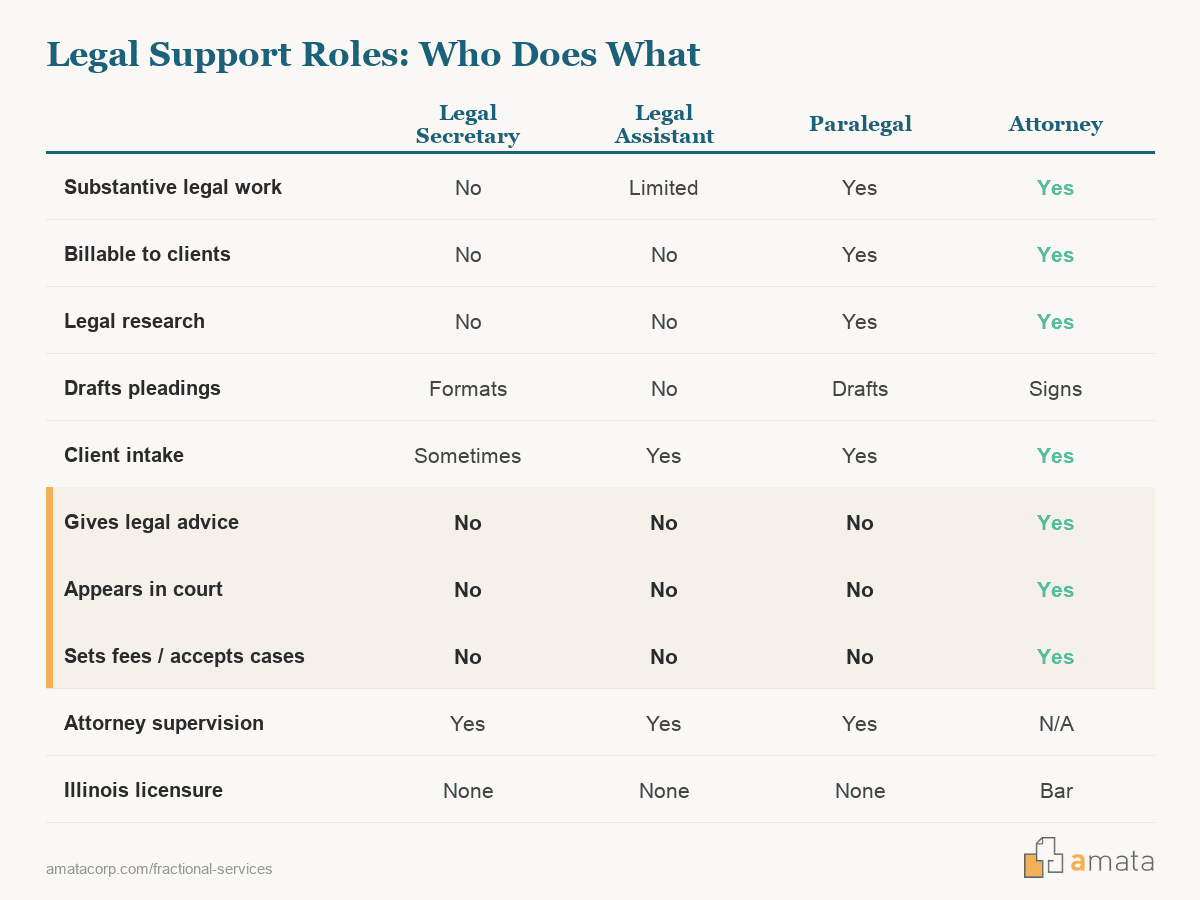
Four-column chart comparing legal secretary, legal assistant, paralegal, and attorney across substantive legal work, billability, legal research, drafting, court appearance, and Illinois licensure
Legal secretaryLegal assistantParalegalAttorney
Substantive legal workNoLimitedYesYes
Billable to clientsGenerally noGenerally noYesYes
Legal researchNoNoYesYes
Drafts pleadingsFormats themNoDrafts themSigns them
Client intakeSometimesYesYesYes
Gives legal adviceNoNoNoYes
Appears in courtNoNoNoYes
Sets fees / accepts casesNoNoNoYes
Requires attorney supervisionYesYesYesN/A
Illinois licensureNoneNoneNoneIllinois bar admission
Typical Amata rate$70/hr$70/hr$90/hr

The three bolded cells in the paralegal column are the ones that matter legally. Everything else is a question of economics and fit. Those three are a question of professional responsibility.

Which role does your firm actually need?

Most small firms need administrative support first and paralegal support second — in that order — and hire them in the reverse order. The instinct is to hire for the legal work because that feels closest to the practice. But the hours that disappear first are usually intake, scheduling, filing, and follow-up.

Try this before you hire anything. Write down every task you personally did last week that someone else could have done. Then sort the list into two columns: work that needed your legal judgment and work that didn't. Total the hours in the second column and multiply by your billing rate.

Two things usually happen. The number is larger than expected. And the second column is overwhelmingly administrative, not substantive — which tells you what to hire.

If the substantive column is the fat one, you need paralegal support. If it's the administrative column, you need administrative support or, at a more senior level, executive assistant support. Most firms need some of both, which is why we don't make people choose one and sign a year for it.

And if you can genuinely fill forty hours a week, every week, hire someone full-time. A fully utilized employee is the better economic answer, and anybody who tells you otherwise is arguing against arithmetic. Fractional staffing exists because most solo and small firms cannot fill those hours — not because full-time employment is a bad idea.

Frequently asked questions

A paralegal performs substantive legal work under attorney supervision — drafting, research, document review — and that time is billable to clients. A legal assistant handles administrative work: intake, scheduling, correspondence, and file management. The titles are often used interchangeably, so evaluate the actual duties rather than the job title.

No. A legal secretary handles document production, calendaring, filing, transcription, and phone coverage — administrative and clerical work. A paralegal produces legal work product: drafts pleadings, conducts research, reviews documents. The secretary formats and files the brief; the paralegal drafted it. Only paralegal time is generally billable to clients.

No. Giving legal advice is the practice of law and is reserved to licensed attorneys. A paralegal also cannot represent clients in court, accept cases, set fees, or sign pleadings. Delegating any of those constitutes unauthorized practice of law, and the supervising attorney bears the professional responsibility.

Not for legal representation or advice. A paralegal cannot advise you on your rights, appear in court on your behalf, or take your case. Independent document-preparation services exist in contested legal territory that varies by state. In Illinois, legal advice requires a licensed attorney in good standing.

Generally yes, when the work is substantive legal work rather than administrative. In Missouri v. Jenkins (1989), the U.S. Supreme Court held that paralegal time is compensable at prevailing market rates in statutory fee-award cases. Administrative time — calendaring, filing, phones — is generally not billable.

No. Illinois does not license, certify, or register paralegals, and there is no state exam. Voluntary national certifications through NALA and NFPA signal training but confer no authority to practice. What governs the work is the supervising attorney's professional responsibility, which cannot be delegated to a vendor.

A law clerk is usually a law student or recent graduate doing supervised research and writing, typically temporarily as part of their training. A paralegal is a career professional in an ongoing role. The work overlaps, but in Illinois, law students may perform certain functions under Supreme Court Rule 711 that paralegals cannot.

A licensed attorney in good standing. Under ABA Model Rule 5.3, adopted in substance in Illinois, an attorney is responsible for the conduct of non-lawyer assistants working on their matters. That obligation applies equally to in-house staff and outsourced providers, and it does not transfer to the vendor.

Usually administrative support. The hours that disappear first for most solos are intake, scheduling, filing, and follow-up rather than substantive legal work. List every task you did last week that someone else could have done, sort by whether it needed legal judgment, and hire against whichever column is larger.

Amata's published rates are $70 an hour for administrative support and $90 an hour for paralegal support, billed in sixth-of-an-hour increments. Monthly programs run $980 for twenty administrative hours, $1,650 for thirty executive assistant hours, and $2,520 for forty paralegal hours, with 32% off hourly rates.

The part that actually matters

Twenty-four years in, having supported more than 1,800 firms — roughly 800 attorneys and professionals are in our community right now — I've stopped believing that the title question is the interesting one.

What's interesting is that most attorneys carry an enormous amount of work that somebody else could do, and they carry it because sorting out who should do what feels like one more project on a list that's already too long. So they keep doing it themselves, and the hours go somewhere, and the practice grows slower than it should.

You don't need to solve the taxonomy. You need to write down what you did last week and be honest about which parts required a law degree.

Talk it through with us: 312.924.0200 or [email protected]. We'll tell you which role you actually need, including when the answer is one we don't sell.

Ron Bockstahler is the founder and CEO of Amata Law Office Suites, a vendor member of the Chicago Bar Association, supporting Chicago-area law firms since 2002. He co-hosts The 1958 Lawyer podcast.

Amata Law Office Suites is not a law firm and does not provide legal services to the general public. All legal support services are performed under the supervision of a licensed attorney in good standing. This article is general information, not legal advice.

Sources: Missouri v. Jenkins, 491 U.S. 274 (1989) on paralegal billing. ABA Model Rule 5.3 on supervision of non-lawyer assistants. Illinois ARDC on attorney registration and discipline.

Law Firm Business Development That Creates Predictable Revenue

Law Firm Business Development.

If business development feels like a string of random lunches, half-finished follow-ups, and “we should post more” meetings, the problem usually isn’t effort. It’s the lack of a clear revenue target and a simple plan that turns that target into weekly actions.

The best law firm business development systems look boring on purpose. They tie goals to lead sources, intake, billing, and cash collection, with just enough structure to hold people accountable. Relationship-building still matters, but it runs on math and consistency. A strong local presence helps too, especially in a market like Chicago where a credible business address and real meeting space can change how prospects and referral partners judge your firm. If you want a built-in relationship channel, consider the Amata Referral Network for Growing Law Firms , which is designed around vetted attorney-to-attorney referrals.

This guide lays out a practical path: set revenue targets, build steady lead flow, tighten intake, improve billing terms, and add monthly recurring revenue where it fits.

Set revenue goals that guide every business development move

“Get more clients” isn’t a goal. It’s a wish. A revenue goal forces choices, how many matters you need, which practice areas to push, how many consults to run, and what your firm can actually handle without blowing up service quality.

Start with an annual revenue goal that matches reality. Look at last year’s collected revenue, then pick a target that accounts for capacity, staff support, and pricing. For many small firms, a 10 to 30 percent increase is aggressive but possible, if intake and follow-up are strong. If you’re changing your model (new niche, new fee structure, new location), keep the first goal tighter and focus on consistency.

Then break it down:

  • Annual goal divided by 12 equals your monthly target.
  • Monthly target divided by your average fee equals matters needed per month.
  • Matters needed divided by your close rate equals consults needed.
  • Consults needed divided by your show rate equals scheduled consults.
  • Scheduled consults divided by your lead-to-consult rate equals leads required.

A simple formula to keep in view is:

Required leads = Revenue goal ÷ Average fee ÷ Close rate ÷ Show rate

Plain examples (illustrative math, adjust to your firm):

  • Family law, flat-fee matters : $360,000 annual goal, $6,000 average fee, 40% close rate, 80% show rate. You need about 188 leads a year, about 16 leads per month.
  • Business litigation, higher fees : $900,000 annual goal, $30,000 average fee, 30% close rate, 75% show rate. You need about 133 leads a year, about 11 leads per month.
  • Estate planning packages : $480,000 annual goal, $4,000 average fee, 45% close rate, 85% show rate. You need about 313 leads a year, about 26 leads per month.

Who owns the number? Assign it to one person per practice area, usually a partner or practice lead. That person doesn’t “do all the marketing.” They keep the scorecard honest and make sure weekly actions happen.

Review cadence matters. Look at the scorecard weekly (15 minutes), and do a deeper review monthly. Don’t wait for a bad quarter to notice you’re short on consults.

Track a short list of metrics that connect to cash:

qualified leads, consults scheduled, show rate, signed engagements, average fee, time to invoice, cash collected.

Turn your goal into a simple math plan your team can follow

Business development falls apart when the plan lives in one partner’s head. Turn your revenue goal into a one-page math plan the whole team can read.

Here’s a step-by-step example for a small business law practice with a mix of matters:

  1. Revenue goal : $600,000 for the year.
  2. Monthly target : $50,000.
  3. Average case value : $7,500 (mix of entity work, contracts, and disputes).
  4. Matters needed : $50,000 ÷ $7,500 = about 7 matters per month.
  5. Close rate : 35% of consults sign.
  6. Consults needed : 7 ÷ 0.35 = 20 consults per month.
  7. Show rate : 80% show for scheduled consults.
  8. Scheduled consults needed : 20 ÷ 0.80 = 25 scheduled consults per month.
  9. Lead-to-consult rate : 50% of qualified leads schedule.
  10. Qualified leads needed : 25 ÷ 0.50 = 50 qualified leads per month.

Before you commit to the numbers, confirm a few assumptions:

  • Capacity : Can your current team handle 7 new matters monthly plus ongoing work?
  • Staffing : Who schedules consults, gathers documents, and follows up?
  • Practice mix : Are you pushing higher-value matters or low-margin work?
  • Fee fit : Does your pricing match the clients you’re targeting?

When the math plan is clear, your weekly question changes from “Should we network more?” to “We need 50 qualified leads this month, what activities produce them?”

Pick the right scorecard, so you know what to fix each month

A scorecard should point to the fix. If your signed matters are down, is the issue lead volume, consult quality, or follow-up? Track KPIs that tell you where the leak is.

Use 6 to 10 KPIs, define them in plain language, and review the trend line each month:

  • Qualified leads : People who meet your basic criteria and have a legal need you handle.
  • Consults scheduled : Qualified leads with an appointment on the calendar.
  • Show rate : Percent of scheduled consults that actually happen.
  • Signed engagements : New clients who sign and meet your intake requirements.
  • Close rate : Signed engagements divided by completed consults.
  • Average fee : Average collected or billed amount per new matter (pick one and stay consistent).
  • Time to invoice : Days from work performed to invoice sent.
  • Time to collect : Days from invoice sent to cash received.
  • Referral meetings held : Short count of actual relationship conversations, not “networking events attended.”
  • Follow-up speed : Time from inquiry to first response.

What trends mean in practice:

If leads are steady but close rate falls, your consult process or offer is off. If consults are scheduled but show rate drops, confirmation and reminders need work. If signed matters are up but cash lags, your billing terms, replenishment language, and invoicing speed are the problem. The scorecard keeps your team from arguing about opinions, because the numbers tell you what to adjust.

Build a steady flow of leads, referrals, and trust

Most firms don’t have a lead problem. They have a consistency problem. A good month comes from a speaking gig, a big referral, or a lucky search result, then the pipeline goes quiet because no one repeated the actions that created it.

The lead channels that tend to work for law firms are straightforward:

Referrals from other attorneys and allied pros, past clients, local networking, speaking and teaching, content that answers common questions, and selective ads when you can track what converts. The “best” channel is the one you can run every week without burning out.

Niche helps. Clients don’t want a buffet. They want a clear answer to, “Do you handle my kind of problem, and can you explain it in plain language?” You don’t need to narrow to one exact issue. You do need a clear offer and a clear starting point, like a fixed-fee package, a paid consult, or a defined first step.

Trust is the multiplier. Prospects decide if you’re “real” before they talk to you. Referral sources do the same. A professional presence signals stability: responsive phone answering, a reliable place to meet, and a consistent experience from the first call to the signed agreement. In Chicago, a strong business address and well-run meeting space can make an early difference, especially when you’re competing with firms that look larger than they are.

Referral sources that actually send matters and how to earn more of them

Referrals are still the most dependable channel for many practices, but they don’t happen by accident. Build a short list and treat it like a real pipeline.

Start by identifying 10 to 20 targets that already serve your ideal clients:

Other attorneys (different practice areas), CPAs, financial advisors, realtors, therapists (for family law), business brokers, insurance pros, and trade groups. Pick people who are active, responsive, and respected.

Then earn repeat referrals by being easy to work with. Referral partners want three things: their client treated well, updates without chasing you, and no surprise conflicts.

What to offer:

  • Fast status updates and a clear point of contact.
  • A simple conflicts process and quick “yes or no” on acceptance.
  • Co-marketing that educates (joint webinar, short FAQ, guest article).
  • A clean handoff back to them after the matter ends.

A simple monthly outreach routine can keep the engine running:

Week 1: reconnect with two existing partners.
Week 2: meet two new targets.
Week 3: send one useful resource to your network (short email, not a newsletter essay).
Week 4: follow up with open loops (people you met, pending referrals, thank you notes).

A first-meeting script outline that doesn’t feel salesy:

  • “What types of clients do you serve most often?”
  • “What legal issues come up around that work?”
  • “What do you wish lawyers did better during a referral?”
  • “Here’s how my firm handles intake, updates, and conflicts.”
  • “If it makes sense, let’s try a small referral and see how it goes.”

Make intake your growth engine, not a bottleneck

You can’t out-market a messy intake process. This is where firms lose revenue quietly, missed calls, slow follow-up, vague consults, and engagement letters that sit unsigned.

Map the journey from first contact to paid retainer. Each step needs an owner, a time target, and a backup plan.

Intake best practices that protect revenue:

Respond fast, answer the phone live when possible, pre-qualify with a short script, run conflict checks early, schedule consults with clear expectations, and follow up like you mean it. Many firms also need a better handoff between the intake person and the attorney, so the consult doesn’t start cold.

Admin support can change the whole machine when it’s consistent. A virtual assistant, legal assistant, or paralegal (under attorney direction) can handle daily tasks that often steal partner time, such as:

  • Scheduling consults, confirming attendance, and sending reminders
  • Collecting intake forms, IDs, and key documents before the consult
  • Coordinating conflict check intake and routing to the right attorney
  • Setting up client files, templates, and checklist steps after signing
  • Drafting routine emails, status updates, and request lists for review
  • Monitoring trust account replenishment triggers and sending notices
  • Following up on invoices and payment links, then flagging issues early

When support staff operate like a client COO, the goal is simple: take tasks off the attorney’s plate so the attorney can focus on legal work, client relationships, and business growth.

If you want help building that kind of support and a professional base in Chicago, call 312-736-7431 or fill out the form, and ask about becoming the next tenant at Amata Office Centers.

A fast, repeatable intake workflow that raises your signed rate

A strong intake workflow is simple, strict, and kind. It reduces friction for good clients and filters out poor fits.

Use a numbered flow so nothing gets skipped:

  1. Answer and capture : Live answer when possible, otherwise return calls within 15 minutes during business hours.
  2. Qualify : Confirm practice fit, urgency, location, and ability to pay (in plain language).
  3. Conflict check : Start it before you offer advice; aim for same-day clearance.
  4. Schedule the consult : Offer two time options; collect a consult fee if that’s your model.
  5. Confirm and prep : Send calendar invite, location or video link, and a short document request.
  6. Run the consult : Give a clear plan, clear fee options, and clear next steps.
  7. Send engagement : Same day whenever possible, with a short email summary.
  8. Collect payment : Retainer or first invoice paid before work begins (with limited exceptions).
  9. Onboard : Welcome email, document checklist, and first milestone date.

Response time targets that move the needle:

  • New inquiry response: within 15 minutes to 2 hours
  • Missed call callback: within 30 minutes
  • Post-consult engagement sent: same day
  • Follow-up for undecided leads: 1 day, 3 days, 7 days (then close the loop)

No-shows happen. Treat them like recoverable revenue. Send a polite reschedule link within 10 minutes, call once, then follow up the next day.

Engagement letters, billing terms, and getting paid without friction

Many firms sign the client, then lose momentum on payment. Clear terms prevent that.

Match your engagement letter to your billing type:

Hourly work needs clear scope language and retainer replenishment terms, so you don’t become the bank. Flat-fee work needs clear deliverables and exclusions, so the fee stays profitable. Contingency work needs clear cost terms and decision points. Hybrid arrangements can work well when the case has uncertainty, but the client needs predictable payment.

Practical clauses that reduce future disputes:

  • Scope and what’s not included
  • Communication expectations (who to contact, response times)
  • Change orders for new work outside scope
  • Billing cadence and invoice delivery method
  • Payment methods accepted, including card or ACH where permitted
  • File closing terms and record retention basics

Billing trends in January 2026 are not subtle. Clients want clarity. They want defined packages, plain-language estimates, and monthly options for ongoing needs. If your billing reads like a mystery novel, you’ll spend more time collecting than practicing.

Add monthly recurring revenue with offers clients can say yes to

Recurring revenue isn’t right for every practice, but it can stabilize cash flow and smooth out the feast-or-famine cycle. It works best when clients have ongoing legal needs and value quick access over one-off projects.

Business clients are a common fit. Many don’t need a full-time general counsel, but they do need steady contract review, policy updates, employment guidance, and someone who can respond fast when a deal heats up.

To make recurring revenue profitable, package it with boundaries:

Define scope, response times, who can contact you, and what counts as out-of-scope work. Track utilization and margin. If one client consistently uses 2 times the planned hours, fix the tier, raise the price, or move them to hourly for overflow.

Simple tiers also make selling easier. Clients like choices, but not a 12-option menu. Two or three tiers is usually enough.

Recurring offers connect back to your revenue math. If you know you want $50,000 per month, a base of monthly clients can cover part of that before you sign any new matters. That reduces pressure, which improves decision-making in intake and pricing.

Fractional general counsel on a flat monthly fee, how to package it safely

A fractional general counsel offer should feel clear and calm, not vague. Here are three tier examples in plain language (adjust to your jurisdiction rules and your firm’s capacity):

  • Starter (foundations) : Up to 3 hours per month of contract review and business Q&A, one 30-minute call, basic policy review once per quarter.
  • Growth (active operator) : Up to 6 hours per month, two calls, contract templates, light employment guidance, vendor and customer agreement reviews.
  • Premium (deal pace) : Up to 10 hours per month, priority response times, more calls, quarterly risk review, support for negotiations (with defined limits).

In every tier, state exclusions clearly: litigation, court appearances, complex tax, and anything requiring specialty counsel unless separately agreed.

Rules that protect the firm:

  • Conflicts checks still apply, even for “quick questions.”
  • Document advice in writing, even short emails.
  • Define response times honestly, then meet them.
  • Set an overflow rate for work beyond the monthly hours.
  • Review utilization quarterly, and adjust pricing when the data supports it.

The goal isn’t to trap clients in a subscription. It’s to provide consistent value without scope creep quietly eating your calendar.

Conclusion

Strong law firm business development is simple when you make it measurable. Set a revenue goal, turn it into lead and consult targets, choose a few lead channels you can run every week, and fix intake so good prospects don’t slip away. Then tighten engagement letters and billing terms so signed work turns into cash, and consider recurring revenue offers where ongoing support makes sense.

If you want to grow across Chicago and Illinois, a credible business address and a support team that keeps intake and admin moving can raise trust fast. Call 312-736-7431 or fill out the form, and ask how to become the next tenant at Amata Office Centers.


Cheap Virtual Office Chicago: How to Get a Real Business Address Without Surprise Fees

How to Get a Real Business Address Without Surprise Fees.

A “ cheap virtual office Chicago ” plan sounds simple. Pay a low monthly rate, get a Chicago address, and keep your overhead under control. For busy owners, attorneys, and professional firms, that can feel like the perfect middle ground between working from home and signing a long lease.

But “cheap” can turn into expensive fast when basics are treated as add-ons. Mail scans cost extra, forwarding is billed per piece, calls rack up per minute, and meeting rooms come with minimum blocks and cancel fees. The ad price may be real, it just may not be the price you end up paying.

This guide breaks down what a virtual office is in plain terms (business address, mail handling, phone answering, meeting space access), what should be included, and how to compare offers so you can choose a plan that fits how your firm actually works.

What you should get for the price (and what is usually extra)

A virtual office is not a single service, it’s a bundle. You’re paying for a professional business presence in Chicago without renting full-time space. The best value is usually predictable monthly pricing , not the lowest number on the pricing page.

Most reputable options include a real street address and some level of mail handling. After that, providers vary widely. Some plans are “address only.” Others include receptionist services, mail scanning, and credits for meeting rooms or day offices.

Before you compare price tags, compare what you’re actually buying: credibility, privacy, time savings, and the ability to meet clients when you need to.

The basics that should be included in a real virtual office plan

If a plan is marketed as a true virtual office (not just a mailbox), these items should be part of the core package:

  • Professional business address : A real street address that looks credible on your website, letterhead, and client communications.
  • Mail receipt and sorting : Staff accepts mail during business hours and organizes it reliably.
  • Secure mail storage : Locked or controlled storage that protects sensitive documents.
  • Mail notifications : Alerts when mail arrives so you’re not guessing.
  • Reasonable pickup access : Clear pickup hours that work for working professionals.
  • Change-of-address guidance : Practical support for updating banks, vendors, courts, and business filings (not legal advice).
  • Basic compliance support for mail handling : A provider should be able to explain required USPS steps for mail authorization and identity verification, and how they handle chain of custody.

A real office address matters because people check it. Clients, banks, vendors, and even opposing counsel may look at your public footprint. An address that feels like an afterthought can raise questions you don’t want to answer.

Common add-ons that raise the bill each month

Many “cheap” plans stay cheap only if you never use them. Watch for fees that kick in the moment you start operating like a real firm:

  • Mail scanning limits (then per-page or per-envelope charges)
  • Mail forwarding billed per piece , plus postage and handling
  • Certified or registered mail handling fees
  • Package acceptance fees (sometimes defined by size, sometimes by carrier)
  • Registered agent upsells (often bundled into a higher tier)
  • Phone line setup fees and monthly phone service charges
  • Per-minute call charges or caps on receptionist minutes
  • Receptionist “after-hours” rules that trigger extra billing
  • Meeting room rates with minimum blocks, deposit requirements, or cancel fees
  • Printing and admin tasks billed at premium hourly rates
  • After-hours mail pickup fees or “appointment” pickup charges

A quick way to keep control is to ask one simple checklist question for every feature: Is it included each month, or is it extra? If it’s extra, ask for the exact rate and the trigger (per piece, per minute, per hour, per page).

How to compare cheap virtual office packages in Chicago without getting burned

“Cheap” and “affordable” aren’t the same. Cheap is a low sticker price. Affordable is a plan you can run month after month without getting nickeled and dimed.

Use this easy comparison method, and you’ll spot the real deal quickly:

  1. Estimate your monthly usage : How many mail pieces, packages, and phone calls do you get in a normal month, and in a busy month?
  2. Match the plan to your workflow : If you meet clients twice a month, an address-only plan is not the right fit.
  3. Price the add-ons you’ll actually use : Treat “optional” services like real costs if you’ll need them.
  4. Confirm the rules : Pickup windows, scanning turnaround time, call answering hours, room booking terms, and privacy policies.

The right plan depends on three things: mail volume, call volume, and meeting frequency. When those are clear, the best option usually becomes obvious.

Use a true monthly cost test, not the advertised starting price

Here’s a simple formula you can copy into a note and use across providers:

True monthly cost = base price + average mail fees + phone fees + meeting room time + setup fees

Don’t base your decision on your lightest month. Pick a realistic month, like a trial-heavy stretch for a law firm, or quarter-end for a CPA practice. Then run the numbers.

Ask for the full fee schedule in writing, including setup fees, deposits, and any “starting at” conditions. Also look at contract length and renewal terms in plain language. Month-to-month flexibility is valuable if your caseload changes, or if you plan to upgrade later.

Questions to ask before you sign

Use these questions on every sales call and keep the answers in one place:

  • What’s included each month, line by line?
  • What triggers extra charges, and what are the rates?
  • Are there any minimums (minutes, scans, forwarding requests, room hours)?
  • What counts as a “package,” and are there size limits or carrier rules?
  • What are the scanning limits, and what’s the turnaround time?
  • What forwarding options exist, and how are fees calculated?
  • Who answers the phones (live staff or overflow), and what are the answering hours?
  • Can calls be recorded, and how is consent handled?
  • How is mail handled for privacy and chain of custody?
  • How often are meeting rooms available, and what are the booking and cancel rules?
  • Is the address suitable for a Google Business Profile listing, if you plan to pursue one?

Clear answers here prevent frustration later.

What attorneys and professional firms should prioritize (beyond “cheap”)

For attorneys and professional services, the biggest risk is not paying a few dollars more. It’s losing time. If your virtual office plan creates extra admin work, you pay for it in interruptions, missed calls, and delayed follow-ups.

Think in two lanes:

  • Address-only support : best for low mail volume and almost no client meetings.
  • Support-forward service : best when you’re client-facing, busy, and want help handling the flow of a real practice.

A support-forward plan can reduce the “small stuff” that eats billable hours: tracking mail, returning calls, confirming appointments, and coordinating documents.

Admin and receptionist support that feels like an extension of your team

A live receptionist and on-demand admin support can act like your front desk and back office, without full-time payroll. For law firms, this can be the difference between “we’ll call you back” and “we can help you now.”

Examples of how attorneys use receptionist, virtual assistant, legal assistant, or paralegal support (under attorney supervision where required):

  • New client intake, capturing key facts, and routing to the right attorney
  • High-level conflict-check intake steps (collecting names and entities for your internal review)
  • Scheduling consults and sending reminders for court dates or deadlines you set
  • Coordinating with process servers and confirming service status
  • Managing document requests and tracking what’s received
  • Triaging urgent calls (judge, clerk, existing client) vs. routine inquiries
  • Preparing basic templates, organizing files, and supporting e-filing workflows

Amata Office Centers describes this as a COO-style approach : taking recurring tasks off your plate so you can focus on clients, work quality, and growth.

Meeting space access when you need it, not every day

Even if you work remotely, you still need a professional place to meet. Client consults, deposition prep, mediations, and document signings go better in a private room with reliable Wi-Fi and a calm reception experience.

Before you rely on meeting space, confirm the details: room sizes, privacy, guest check-in support, included tech, hourly blocks, minimums, and cancel fees. A “cheap” plan can become pricey if the only workable room option is billed at premium rates.

If you want to see how a legal-focused setup can work, review Professional virtual office space in Chicago and compare what’s included versus what’s billed as needed.

A simple way to choose the right option, and the next step if you want help

Choosing comes down to being honest about your workload, then picking a plan that won’t punish normal use.

Pick the plan that matches your workload today, with room to grow

  • Choose address-only if you get rare mail, don’t need call answering, and never meet clients.
  • Choose a bundled plan if you get weekly mail, want mail scans, need call handling, or expect occasional meeting room use.
  • Choose a support-heavy plan if you’re client-facing, you’re in court often, or interruptions are costing you billable time.

A good provider will let you scale up or down as your caseload changes, without making you start over.

If you want a second set of eyes on your options, call 312-736-7431 or fill out the form to talk through a virtual office plan. If the fit is right, step in as the next tenant at Amata Office Centers.

Conclusion

A cheap virtual office can be a smart move, but only if you know what’s included and what’s extra. Compare plans by real monthly cost, watch the add-ons, and choose the level of support that protects your time and your reputation. For a plan that fits how professional firms actually operate, call 312-736-7431 or fill out the form and talk with Amata Office Centers about a virtual office setup that can take work off your plate.

Chicago Start Ups: How to Choose a Business Location That Wins

How to Choose a Business Location That Wins.

In Chicago, your address is more than a pin on a map. For chicago start ups and professional services firms, where you base the business can shape trust, cash flow, hiring, and client access in the first 12 to 24 months. If you’re building a law firm, accounting practice, consulting shop, recruiting firm, insurance agency, or real estate services business, your location helps people decide if you’re “real” before they ever meet you.

If you need a flexible option, Amata Office Centers offers Virtual office solutions in Chicago plus private offices, meeting space, and real support. To talk through fit, call 312-736-7431 or fill out the form. It’s a practical way to get a credible address fast, without signing a long lease.

This guide breaks down how to pick a start up business location chicago entrepreneurs can actually afford, whether you need a virtual address, meeting rooms on demand, or a private office you can use every day. You’ll learn what signals trust, what costs to watch, and how to choose a setup that still works when your workload changes.

Pick a start-up business location in Chicago that builds trust fast

In professional services, trust is the product. Clients often can’t judge your work until after they hire you, so they judge everything around it. Your address, building, lobby, and the way clients are greeted all become part of the “proof” that you’re established.

A strong business location improves real outcomes, not just image. It can mean fewer missed meetings, fewer awkward first minutes, and more signed engagements. When a client can park, find the elevator, and walk into a clean conference room with a friendly greeting, the meeting starts on your terms.

Here’s what “trust” looks like in the real world:

  • Safe building and surroundings : Clients don’t feel on edge arriving or leaving.
  • Professional lobby : The first five seconds feel calm and organized.
  • Clear wayfinding : Easy directions, good signage, simple check-in.
  • Staffed reception : Someone answers, greets, and helps.
  • Clean, private conference rooms : Quiet, tidy, and ready on time.

That’s why the right setup matters for start up companies in chicago that sell expertise. You’re not only choosing a workspace, you’re choosing your first impression.

Your clients decide in minutes, your address is part of the pitch

People notice small things because small things signal bigger ones. If the lobby is chaotic, they assume your process is chaotic. If the building feels hard to access, they wonder what else will be hard.

Think about common early-stage moments:

A general contractor meets you to talk about a claim and wants to see that you run a tight shop. An investor intro happens last-minute and you need a place that doesn’t feel like an afterthought. A bank call turns into “can we meet tomorrow,” and you need a room that supports serious conversations. A court-adjacent consult requires a location that’s easy for clients, witnesses, or co-counsel to reach.

For many start up companies in chicago, a strong business address helps even before a full team is hired. A solo founder with the right location can look organized, reachable, and ready. That’s often the difference between “I’ll think about it” and “send me your engagement letter.”

Virtual office vs private office, choose based on how you sell and serve

There isn’t one “right” answer. A virtual office can be perfect if you’re mostly remote, travel often, or only meet clients a few times a month. A private office can be the better choice if you need routine, privacy, and daily workspace.

A simple way to think about it:

A virtual office is for presence and support. You get a credible business address, mail handling, and often call answering, plus meeting rooms when you need them.

A private office is for daily work. You get a dedicated space for confidential calls, focused writing, client meetings, and a steady place to run the firm.

Quick decision checklist:

  • Client meetings : If you meet people weekly, private office or frequent meeting-room access helps.
  • Privacy needs : If you handle sensitive info daily, a private office is safer than shared spaces.
  • Budget : If you’re watching every dollar, a virtual office can keep overhead lower.
  • Team size : If you’re solo or mostly remote, virtual can work well. If you have staff on-site, private office usually fits better.
  • Travel schedule : If you’re rarely in one place, virtual keeps you flexible without losing credibility.

What matters most in the first few years: cost control, flexibility, and support

Early-stage revenue can be uneven. One month feels full, the next one feels quiet. That’s normal for new firms, even when the work is good. The problem is that traditional offices don’t care about “normal.” They care about fixed costs and long commitments.

A standard lease can come with expenses that don’t show up in the rent number. Before you commit, it helps to see the whole picture.

Common hidden costs in a traditional lease include build-out, furniture, internet contracts, utilities, cleaning, insurance, security deposits, and time spent chasing vendors. Even if you find a “deal,” you can lose weeks setting up, and weeks matter when you’re trying to sign clients.

Flexible office options solve a simple problem: you can look established without locking yourself into a setup that doesn’t match the next six months. You can add services when you’re busy, or scale back when you’re not. For chicago start ups, that flexibility is often the difference between staying calm and feeling squeezed.

Avoid long lease traps that drain cash and slow decisions

Long leases can be fine for mature companies. For a new firm, they can be a weight you carry every day. The risk isn’t only the monthly bill, it’s the lack of control.

Common pain points:

  • Multi-year terms that outlast your current business model
  • Personal guarantees that put personal finances on the line
  • Surprise CAM charges and operating expense increases
  • Slow maintenance response when something breaks
  • Time spent managing vendors for internet, cleaning, repairs, and supplies

Flexible office setups can reduce that risk while keeping you professional. If you can move in quickly, keep costs predictable, and upgrade only when you need to, you protect cash without looking “small.”

Admin support can feel like a part-time COO for a small firm

Founders don’t fail because they can’t do the work. They burn out because they try to do everything around the work. Calls, scheduling, mail, intake, follow-ups, formatting, payments, room setup, and basic admin can eat the best hours of the day.

Amata Office Centers takes the approach that support can function like a client’s COO , handling daily tasks so the founder can focus on growth and client work. For attorneys and professional services firms, that’s not “nice to have.” It’s often how you keep quality high while staying lean.

Concrete examples of how an attorney can use admin support, a virtual assistant, a legal assistant, or paralegal help (under attorney direction where required):

A live receptionist answers calls, routes them properly, and schedules consults so you don’t miss good leads. Intake steps can be organized with your process, including basic conflict-check prompts you provide, and reminders for prospects who haven’t booked. Client follow-ups can go out after meetings, keeping matters moving without you writing every message. Documents can be formatted to your style, and e-filing packets can be prepared for your review and submission under your supervision. Calendars can be managed so deadlines, hearings, and meetings don’t collide. Billing support can help with sending invoices, tracking what’s paid, and flagging what needs attention. Couriers can be coordinated, conference rooms can be set up before clients arrive, and mail, packages, and certified letters can be handled with care.

Tasks you can stop doing (or do less of):

  • Answering every call during deep work time
  • Chasing scheduling emails back and forth
  • Printing, scanning, and organizing mail at home
  • Setting up meeting rooms right before clients arrive
  • Formatting routine documents and letters
  • Coordinating deliveries and pickups during busy days
  • Tracking simple billing admin that pulls you off client work

When your support system is reliable, your day stops feeling like a pile of interruptions. Your clients notice the difference.

Search engines use the business address to decide how it will boost SEO and GEO rankings

Your location choice affects marketing too. Search platforms want to show local results they can trust, and a verified business address helps build that trust. For many professional services firms, your Google Business Profile, maps visibility, and local directory listings all depend on consistent address information.

A weak setup can cause problems. If your address can’t be verified, your profile can be delayed, suspended, or harder to rank. If you use a home address, you might trade visibility for privacy, and many founders regret that later. If you use an address that doesn’t handle mail securely, you can create a new risk while trying to solve an old one.

A solid start up business location chicago plan considers three things at the same time:

First, can you use the address in a way that meets platform rules and business registration needs? Second, will the address stay stable for at least a year so you don’t have to change it everywhere? Third, can you protect privacy and sensitive documents while still showing a legitimate presence?

If you serve clients in-person, or if clients search “near me,” a professional address can help you show up where decisions happen. If you serve clients across the city, the right location can also reduce friction when meetings do happen.

A simple location checklist for Chicago start-ups choosing an office or virtual address

Choosing a location feels like a big decision because it is. A good choice supports growth, a bad one creates daily headaches. The goal isn’t to impress everyone in Chicago, it’s to fit your clients, your budget, and how you actually work.

Start with your reality, not your wish list. If you only meet clients twice a month, don’t pay for space you won’t use. If you handle sensitive documents, don’t pick a setup that treats privacy as an afterthought. If your schedule changes week to week, don’t lock yourself into something that makes every change expensive.

For professional services, compliance and privacy matter. Look for secure mail handling, package controls, and meeting rooms where conversations stay private. You’re protecting more than paper. You’re protecting trust.

If you want help comparing options, call 312-736-7431 or fill out the form to tour locations or talk through fit. If the goal is to look established without getting stuck, it’s worth discussing what you need now and what you’ll need six months from now. Then take the next step and be the next tenant at Amata Office Centers.

Run this quick test before you sign anything

  1. Where do clients come from? Map the top neighborhoods or suburbs you serve.
  2. Commute and parking: Can clients and staff get there easily at peak times?
  3. Safety and building access: Does arrival feel comfortable, day and evening?
  4. Conference room access: Can you book rooms when you need them, without hassle?
  5. Receptionist presence: Will clients be greeted, guided, and checked in?
  6. Mail handling and package security: Are sensitive documents protected and tracked?
  7. Internet reliability: Is it stable enough for video calls and file work?
  8. Ability to add offices: Can you grow from one to two offices without moving?
  9. Month-to-month terms: Can you adjust if business shifts?
  10. Total monthly cost: Add every fee, not just base rent.
  11. How fast you can move in: Can you be operational this week, not next quarter?

If 2 to 3 items are weak , keep looking.

Conclusion

For chicago start ups and start up companies in chicago, the right start up business location chicago choice helps you look established, meet clients smoothly, and protect cash early. Virtual offices and private offices both work when they match how you sell and serve. If you want a credible address, flexible space, and support that takes work off your plate, call 312-736-7431 or fill out the form to talk through your needs and become the next tenant at Amata Office Centers. Your address should help you grow , not slow you down.

How to Hire a Paralegal: A Step-by-Step Guide for Small Law Firms

The first paralegal is the hardest hire a small firm ever makes, and it isn't because paralegals are hard to find.

It's because most attorneys making that hire have never hired anyone before. They went from law school to an associate seat to their own shingle, and at no point did somebody teach them how to write a job description, run an interview that surfaces something useful, or figure out what a fair wage is in their market. So they do what feels reasonable — post something on Indeed, interview four people, pick the one they liked most — and then spend the next eight months wondering why it isn't working.

I've watched this happen enough times to know the pattern. The problem is almost never the person hired. It's that the firm hired before it knew what it was hiring for.

In full disclosure: Amata provides paralegal support, so we're one of the options at the end of this. But most of what follows applies whether you hire someone directly, use a staffing firm, or work with us. The process matters more than the provider.

How do you hire a paralegal?

Hiring a paralegal takes six steps: define the actual work in writing, decide whether you need full-time or part-time coverage, set a realistic budget from your local market, write a job description around tasks rather than credentials, interview for judgment rather than software knowledge, and structure the first ninety days deliberately. The step most firms skip is the first one.

Each of those gets its own section below. But the sequence is the point. Firms that hire badly almost always started at step four — writing the posting — before they'd done one through three.

Can I hire a paralegal instead of a lawyer?

No. A paralegal cannot give legal advice, represent you in court or at a deposition, accept a case, set a fee, or sign a pleading. Those five acts are reserved to licensed attorneys. A paralegal performs substantive legal work under an attorney's supervision, which is a different thing from practicing law.

This question comes from two directions, and the answers differ.

If you're a client hoping to save money: a paralegal can't advise you on your rights or take your matter. Independent paralegals who prepare documents directly for the public occupy contested legal territory that varies by state, and in Illinois the safe answer is that legal advice requires a licensed attorney. The ARDC enforces that line.

If you're an attorney working out how much you can delegate: you can delegate far more than most firms do. A paralegal can run discovery, draft nearly everything, manage the file, prepare exhibits, and handle client communication that stops short of advice. What you can't delegate is judgment — and you can't delegate the supervision obligation itself. Under ABA Model Rule 5.3, adopted in substance in Illinois, you're responsible for the conduct of non-lawyers working your matters.

Step 1: Write down the actual work

Before you write a job posting, list every task you did last week that a trained non-attorney could have done, then sort it into two columns: work that required your legal judgment and work that didn't. That second column is the job description. Most firms discover it's mostly administrative rather than substantive.

This takes about twenty minutes and it changes the hire more than anything else on this list.

Two things usually surface. The list is longer than expected — most attorneys underestimate their non-billable load by roughly half. And the work splits unevenly: intake, scheduling, filing, and follow-up dominate, while drafting and research are a smaller share than the attorney assumed.

That matters because it tells you what role you actually need. If the heavy column is administrative, you need a legal assistant or administrative support, and hiring a paralegal means paying a premium for calendar management. If it's substantive, you need a paralegal. Most firms need some of both, and the ratio is what the list reveals.

If the distinction between those roles isn't clear, we wrote a full comparison — it's the single most common place small firms overpay.

Step 2: Decide how many hours you actually have

Add up the hours in your non-legal column and multiply by four to get a monthly figure. If it lands under about 100 hours a month, a full-time hire will be underutilized and you're paying for capacity you can't fill. A full-time paralegal delivers roughly 173 hours a month.

Be honest here rather than optimistic. The temptation is to reason that you'll grow into the hours, and sometimes that's true. But you carry the salary through the slow months either way, and the slow months are exactly when a firm can least afford it.

The math also runs the other way. If you can genuinely fill 173 hours a month with substantive legal work, every month, a full-time employee is the better economic answer and anyone telling you otherwise is arguing against arithmetic.

Step 3: Set a budget from your market, not from a national average

Salary benchmarks vary sharply by metro, and national averages will mislead you in either direction. Amata's own most recent Chicago hire, at four to five years' experience, came to $65,000 in salary plus a bonus worth about $10,800, plus 25% for taxes and benefits — roughly $94,750 before equipment.

In full disclosure, that's what we actually paid rather than a market estimate:

Salary — 4–5 years' experience$65,000
Bonus — 10% of work billed$10,800
Taxes and benefits, 25%$18,950
Subtotal$94,750
Desk, computer, phoneadditional

The bonus structure is worth copying. Tying part of the compensation to work billed means the cost scales with productivity instead of sitting fixed — good for the firm and good for the paralegal.

Two costs firms routinely leave out of that number.

Turnover. SHRM puts replacement cost at 50% to 200% of annual salary once you account for recruiting, lost productivity, and ramp time. That's not a rounding error.

The vacancy. The average paralegal opening takes around eight weeks to fill. Eight weeks during which the work returns to your desk while you're also conducting interviews.

For the full comparison across hiring, fractional, and agency models, we published our own rates and the arithmetic behind them.

Step 4: Write the posting around tasks, not credentials

Describe the work in concrete terms — "draft discovery responses in personal injury matters," "manage e-filing in Cook County," "run client intake and conflict checks" — rather than listing years of experience and software names. Task-specific postings attract candidates who can do the job and screen out the ones who can't.

A note on credentials. Illinois does not license, certify, or register paralegals. There is no state credential and no exam. Voluntary certifications through NALA and NFPA signal training and are worth something, but they confer no authority and they are not a substitute for judgment.

So a posting that leads with "paralegal certificate required" is filtering on the wrong variable. Lead with the work. Ask about the certificate later if you care.

Name the practice area explicitly. A litigation paralegal and a real estate paralegal do genuinely different jobs, and a candidate strong in one may be starting over in the other.

Step 5: Interview for judgment

Ask candidates to walk you through how they'd handle a specific scenario from your practice rather than asking what software they know. Software is teachable in a week. Judgment isn't. The best single question is usually: tell me about a time you caught a mistake before it went out the door.

Three questions that consistently surface something useful:

"Walk me through how you'd prepare for a deposition next Tuesday." You learn whether they think in sequences and whether they anticipate.

"A filing gets rejected by the Clerk. What do you do in the next hour?" You learn how they handle being wrong, which matters more than whether they're often wrong.

"What would you want me to stop doing?" You learn whether they'll actually take work off your desk or wait to be handed it. This one separates candidates more than any other.

Skip the hypotheticals about strengths and weaknesses. Nobody has answered those honestly since 1994.

Step 6: Structure the first ninety days

Decide before day one what work transfers in week one, week four, and week twelve — and write it down. Most hires that fail don't fail on capability. They fail because the attorney never actually let go of the work.

Week one is systems, conventions, and observation. Week four should have the person independently owning at least one recurring process end to end — intake is the usual candidate. By week twelve they should be catching things you'd have missed.

The failure mode is subtle and common. The attorney hires help, hands over some tasks, then quietly keeps doing the rest because explaining it takes longer than doing it. Six months later they're paying a salary and still working sixty hours. If you're going to keep doing the work, don't make the hire.

Also decide who handles the work when this person is out. A single point of failure that takes vacation is still a single point of failure.

Should you hire full-time, part-time, or fractional?

Full-time makes sense when you can fill 173 hours a month. Part-time works if you can find someone good who wants part-time hours, which is harder than it sounds. Fractional makes sense when the work is real but doesn't reach a full seat. The deciding variable is hours, not preference.

Full-time hirePart-time hireFractional program
Hours~173/monthWhatever you negotiate20–40/month, adjustable
Recruiting time~8 weeks~8 weeksNone
You carry the cost when work is slowYesYesNo — scale hours down
Turnover riskYoursYoursProvider's
Coverage when they're outYou arrange itYou arrange itNamed backup on paralegal and admin programs
Training investmentYoursYoursProvider's

The part-time column deserves a warning. Part-time paralegal roles are genuinely hard to staff well, because strong candidates with options usually want full-time work and benefits. Firms that go this route often end up with someone who takes a full-time job four months later.

What does a paralegal cost?

Amata publishes $90 an hour for paralegal support and $70 an hour for administrative support, billed in sixth-of-an-hour increments, or $2,520 a month for forty paralegal hours through Paralegal-40. A full-time Chicago hire runs closer to $95,000 fully loaded before equipment.

Short section on purpose — the full arithmetic, including the break-even math against your billable rate, is in the cost breakdown.

One thing worth flagging while you're comparing providers: e-filing is paralegal work and should bill at the paralegal rate. Some providers bill it as administrative because it looks clerical. A rejected filing is a legal problem, not a clerical one.

What if hiring isn't the answer?

Sometimes the honest answer is that the firm doesn't need a paralegal — it needs to stop taking a certain kind of matter, raise its rates, or restructure entirely. No amount of support fixes a practice built on work the attorney has outgrown.

I see this maybe twice a year, and it's the conversation I care most about getting right. An attorney describes a staffing problem, and what they're actually describing is that they're doing work they don't want to do anymore, in a practice area they've outgrown, alone. Selling them twenty hours a month of support doesn't solve that. It delays it.

We've told people this and watched them not hire us. That's the right outcome. A client who signs for the wrong reason leaves in six months feeling worse than when they started.

The other version: the firm has no documented processes at all. No intake script, no matter-opening checklist, no filing convention. You can still hire — but understand that months one and two cost you time rather than saving it, because you're building the system while training the person. Write down your three most repeated processes before anyone's first day. An hour of work that changes the whole first quarter.

Frequently asked questions

Define the actual work in writing first, decide whether you need full-time or part-time coverage, set a budget from local market data, write a posting around tasks rather than credentials, interview for judgment instead of software knowledge, and plan the first ninety days before day one. Most firms skip the first step.

No. A paralegal cannot give legal advice, represent you in court, accept a case, set a fee, or sign a pleading — those acts are reserved to licensed attorneys. A paralegal performs substantive legal work under attorney supervision, which is different from practicing law.

No. Illinois does not license, certify, or register paralegals, and there is no state exam. Voluntary certifications through NALA and NFPA signal training but confer no authority to practice. What governs the work is the supervising attorney's professional responsibility, which cannot be delegated.

The average paralegal vacancy takes roughly eight weeks to fill, counting posting, screening, interviewing, offer, and notice period. During those weeks the work returns to the attorney's desk. Fractional and agency arrangements start faster because the recruiting and onboarding cycle is already complete.

Judgment above credentials. Ask candidates to walk through a real scenario from your practice rather than listing software. Look for someone who anticipates rather than reacts, handles being wrong without defensiveness, and volunteers what they'd take off your desk without being asked twice.

Usually a legal assistant or administrative support. The hours that disappear first for most solos are intake, scheduling, filing, and follow-up rather than substantive legal work. List every task from last week that someone else could have done and hire against whichever column is heavier.

Amata's most recent Chicago hire, at four to five years' experience, came to $65,000 salary plus a roughly $10,800 bonus, plus 25% for taxes and benefits — about $94,750 before desk, computer, and phone. Amata's published rate is $90 an hour, or $2,520 monthly for forty hours.

Ask how they would prepare for a deposition next week, what they would do in the first hour after a filing is rejected, and what they would want you to stop doing. The third question reveals more than the other two — it shows whether they will take work or wait for it.

Yes, though part-time paralegal roles are difficult to staff well. Strong candidates with options usually want full-time work and benefits, so firms hiring part-time often lose the person to a full-time offer within months. A fractional program provides part-time hours without that turnover exposure.

Week one covers systems, conventions, and observation. By week four the person should independently own at least one recurring process end to end — client intake is the usual first candidate. By week twelve they should be catching issues you would have missed. Decide this sequence before day one.

The part nobody tells you

Twenty-four years in, having supported more than 1,800 firms, the thing I'd most want a first-time hiring attorney to know is this: the hire isn't the decision. The decision is what you stop doing.

Firms that get this right hand over a category of work and then genuinely stop touching it, even when they could do it faster themselves that week. Firms that get it wrong hire someone, delegate the easy parts, and keep the rest — then conclude six months later that the hire didn't work.

Same candidate, same salary, opposite outcome. The variable was never the paralegal.

So before you post the job, answer the harder question: if thirty hours of non-legal work left your desk next month, what would you do with them? If you have a real answer, almost any competent hire will work out. If you don't, no candidate at any salary is going to fix that.

Want to talk it through? 312.924.0200 or [email protected]. We'll tell you honestly if hiring directly is the better move for your firm.

Ron Bockstahler is the founder and CEO of Amata Law Office Suites, a vendor member of the Chicago Bar Association, supporting Chicago-area law firms since 2002. He co-hosts The 1958 Lawyer podcast.

Amata Law Office Suites is not a law firm and does not provide legal services to the general public. All legal support services are performed under the supervision of a licensed attorney in good standing. This article is general information, not legal advice.

Sources: ABA Model Rule 5.3 on supervision of non-lawyer assistants. Illinois ARDC on attorney registration and discipline. SHRM for replacement cost and vacancy duration. The fully loaded staffing figures are Amata's own actual hiring costs for a Chicago paralegal at four to five years' experience, as of August 2026. The 25% figure for taxes and benefits is Amata's estimate applied to salary plus bonus. Individual firm costs vary by experience level, practice area, and market.

Flexible Office Space in Chicago: The Best Solution for Lawyers With Seasonal Workloads

For many law firms and solo attorneys in Chicago, work comes in waves. The need for workspace isn’t a constant—it shifts during trial prep, tax season, settlement periods, or when adding contract attorneys for large projects. Committing to a traditional long-term office lease often means paying for space (and support staff) you may only truly need half the time.


Flexible office space directly solves these issues. The key is working with a provider that understands the legal profession’s unique demands.

Amata Law Office Suites is built for attorneys in Chicago, offering workspace and services that adapt to the real world of modern practice.


True Flexibility: Pay for What You Use, Scale When You Need

Amata Law Office Suites lets you adjust your office footprint to fit your actual workflow:

  • Month-to-month private office rentals: Scale up or down your office without penalties. No 10-year leases that lock you down with a fee.
  • Virtual law office memberships: Need a Chicago Loop business address, client mail acceptance, and conference room booking, but not a full-time office? Get all the credibility and utility, only paying for physical space as needed.
  • On-demand conference rooms: Host client meetings, mediations, or depositions in modern, fully equipped spaces, scheduled by the hour or day.
  • Access to multiple locations: Work where it makes sense—choose from several Chicago Loop and business district offices, depending on client needs or which court you’re visiting.


You never pay for more space than you actually need, and you don’t lose out when your business cycle demands extra space or resources.


Attorney using chicago offices


Virtual law office memberships are available for attorneys who work mostly remotely but still need a prestigious Chicago Loop business address and access to meeting rooms. You look just as professional as larger firms and pay only for what you use.

Meeting and conference rooms are available on demand by the hour or day. This means you can always host impressive client meetings or depositions—even if you’re not in a full-time office.

Amata’s multiple locations in Chicago’s business district let you work wherever is most convenient—close to clients, courts, or your team.


Lawyer, woman and phone call with smile in street for law, justice or human rights with advice for job at court. Attorney, advocate and person with book, contact or documentation for evidence in chicago offices


Lower Overhead, Invest Resources Where They Matter

With Amata, your costs reflect your actual use:

  • No wasted rent: Only pay for offices, meeting rooms, and amenities when you need them.
  • No full-time support staff expenses: Turn on live receptionist, paralegal, and admin support when busy; pause it when things slow down.
  • All-inclusive pricing: Utilities, cleaning, Wi-Fi, office management, and IT are built in. No negotiating contracts, managing vendors, or worrying about hidden fees.
  • Discounted parking and direct transit access: Value for attorneys (and clients) coming from anywhere in the city or suburbs.

In this way, you can shift dollars from fixed office costs to growth, technology, or staff incentives. Also, retain more profits during slow seasons, and invest in winning big cases or capturing new clients when busy.


Fractional Services: Instant Access to a Legal Support Team—Only When You Want It

Staffing is often the hardest part of managing a seasonal workflow. Rather than hiring a full team year-round, Amata offers fractional support tailored to lawyers’ needs.

During a rush, Amata’s staff can handle call overflow, client intake, scheduling, and more. Their live receptionists answer in your firm’s name. You can add experienced, U.S.-based paralegals and admin support quickly for filings, research, and case organization.

When your caseload returns to normal, scaling down is just as simple. You aren’t carrying unnecessary payroll when business is slow.


Hassle-Free Chicago Offices and Operations

With Amata, there’s no need to worry about supplies, maintenance, or technology breakdowns. Secure keycard access, robust IT, professional printing, and mail handling are all included.

You won’t waste time on office logistics or vendor contracts. Everything is handled so you can focus on billable work and client needs.


Make a Lasting Professional Impression

Your office address and meeting environment say a lot about your firm. Amata’s locations, such as 77 West Wacker and 181 West Madison, offer landmark addresses and impressive city views.

Features like a bamboo forest lobby, on-site gym, locker rooms, restaurants, and concierge services help you deliver a “big firm” experience—without the big firm commitment.

Even if you only use these amenities occasionally, your clients and peers will notice the difference.


Adapt Quickly as Workflows Change

Busy law firms can expand easily with Amata. Add offices for contract lawyers during trial season or rent project rooms for major cases.

After a peak, scaling back is instant. No long-term leases, no penalties.

Hybrid setups are easy to arrange. Combine a private office for day-to-day work with a virtual law office for flexibility. Reserve meeting rooms only when you need them.


Connect, Learn, and Grow

Amata’s community is another asset. Lawyers can attend CLEs, business management events, and networking nights to stay updated on legal trends and meet potential partners—for referrals or collaboration.

You’re not just renting space. You’re joining a network of legal professionals who understand the demands of Chicago practice.


Steps for Choosing a Flexible Law Office in Chicago

If you’re searching for a coworking space or flexible office solution, first review your typical workflow. Identify your seasonal peaks, when you need more space or support, and when you can scale down.


Visit office locations in person. Evaluate amenities, technology, and staff. Ask detailed questions about membership terms and true flexibility.


Inquire about support services. Make sure you can add or remove reception, paralegal, or admin help as needed.


Compare pricing. Amata’s all-inclusive rates, bundled amenities, and legal-focused services stand out in Chicago’s market.


Why Amata Stands Out

Amata is more than a basic coworking provider. They offer legal-focused workspaces designed for Chicago attorneys.

Their flexible terms, central locations, experienced support staff, and reliable infrastructure let your practice adapt to the busy seasons—without paying for wasted space.

Your office, support, and community adapt to your needs. You never have to compromise growth or client service because of inflexible real estate.


Get Started

Ready for an office solution that fits your season? Schedule a visit to Amata’s premier Chicago locations. Build a practice that can flex, grow, and succeed—without being limited by your office space.

Why Virtual Office Solutions Are Perfect for Hybrid Law Firms


The challenge isn’t that hybrid work doesn’t work for law firms; it’s that traditional office solutions were designed for a world where everyone showed up to the same building every day. Virtual office solutions solve this disconnect by giving you a professional infrastructure that adapts to how you actually practice law.


You’ve discovered something that many law firms are just beginning to understand: your best work doesn’t always happen in a traditional office.


Maybe you’re more productive drafting briefs from your home office, but you need professional space for client meetings. Perhaps your team collaborates better remotely, but court appearances require a downtown presence. You’re running a hybrid practice, and you need infrastructure that matches your flexible approach.


The Professional Presence Paradox


Here’s the paradox facing hybrid law firms: you need a serious professional presence, but you don’t need it full-time. Your clients expect you to have a prestigious business address, professional phone answering, and access to conference rooms for important meetings. But you might only need these services 20% of the time.


Traditional office leases force you to pay for 100% occupancy to get professional services you use occasionally. Virtual office solutions flip this equation. You get the professional presence when you need it, without paying for space that sits empty most of the time.


This isn’t about cutting corners—it’s about smart resource allocation. When you’re not paying for unused office space, you can invest in better technology, continuing education, or the professional services that directly impact your practice quality.


Your Client Meeting Inconvenience, Solved


One of the biggest challenges hybrid law firms face is client meetings. You can’t invite clients to your home office, coffee shops feel unprofessional, and booking conference rooms elsewhere is expensive and inconvenient. You need reliable access to professional meeting spaces without the overhead of maintaining them full-time.


Virtual office solutions give you on-demand access to professional conference rooms, complete with the technology and amenities your clients expect. When you need to meet with a client, you book a conference room. When you don’t, you’re not paying for empty space.


The psychological impact on clients is significant. They see you operating from a professional downtown address, meeting in well-appointed conference rooms, and handling business with the same polish as traditional firms. The fact that you’re not there every day becomes invisible to them—they only see the professional result.


 Virtual Offices


The Geographic Flexibility Factor


Virtual office solutions unlock geographic flexibility that traditional offices simply can’t match. You can establish a professional presence in multiple markets without the massive overhead of multiple physical offices. If you’re handling cases in different jurisdictions, you can have local addresses and local phone numbers without local leases.


This geographic flexibility also extends to your team. You can hire the best paralegal for your needs regardless of where they live. You can work with the most qualified experts without worrying about their proximity to your office. Your practice becomes location-independent while maintaining professional standards.


The Cost Structure Alignment


The most compelling aspect of virtual office solutions for hybrid firms is how perfectly the cost structure aligns with your actual needs. Instead of paying fixed costs for space you use inconsistently, you pay for professional services based on your actual usage.


When you’re in a busy litigation period and need conference rooms frequently, you use them. When you’re focused on research and writing, you’re not paying for unused meeting space. When you need administrative support, it’s available. When you don’t, you’re not carrying that overhead.


This variable cost structure is particularly powerful for hybrid firms because it allows you to scale your infrastructure up and down based on your actual business needs rather than committing to fixed costs based on projected usage.


The Professional Evolution


Virtual office solutions aren’t just about saving money—they’re about evolving your practice to match how legal work actually gets done in the modern world. You’re not trying to fit your hybrid practice into traditional office constraints. You’re building infrastructure that supports your actual workflow.


This evolution is particularly important for attracting and retaining good legal talent. Top attorneys increasingly expect flexibility in how and where they work. Virtual office solutions let you offer that flexibility while maintaining the professional standards that clients expect.


The Strategic Positioning


Hybrid law firms with virtual office solutions often find themselves with a strategic advantage over traditional firms. You can be more responsive to client needs because you’re not constrained by traditional office hours or locations. You can be more cost-effective because you’re not carrying unnecessary overhead. You can be more attractive to talent because you offer genuine flexibility.


This positioning is becoming increasingly important as clients become more sophisticated about evaluating legal services. They care about results and professionalism, not whether you’re sitting in a traditional office from 9 to 5.


Ready to optimize your hybrid practice infrastructure?


Discover how virtual office solutions can provide the professional presence your hybrid law firm needs without the overhead you don’t. Our team understands the unique challenges of hybrid legal practices and can design solutions that support your flexible approach.


Schedule a Consultation to Explore Virtual Office Solutions

Simplify Case Preparation with Professional Paralegal Support

Simplify Case Preparation with Professional Paralegal Support.

Case preparation doesn’t have to consume your evenings and weekends. The key is partnering with professional paralegal support that can handle the sophisticated preparation work while you focus on the strategic legal thinking that only you can provide.

The Case Preparation Bottleneck

The better you get at winning cases, the more complex your case preparation usually becomes.

What started as a simple document review has evolved into comprehensive discovery management, witness coordination, exhibit preparation, and timeline development. Each case requires dozens of hours of meticulous preparation work before you ever step into a courtroom or mediation room.

You’ve probably tried to handle this by working longer hours, but that’s not sustainable. You can’t scale yourself, and case preparation work has a way of expanding to fill whatever time you give it. The result? You’re spending your most productive hours on tasks that, while important, don’t require your legal expertise.

The reality is that professional paralegal support isn’t just helpful—it’s essential for any attorney who wants to handle complex cases without sacrificing their personal life or their ability to take on new clients.

The Professional Paralegal Advantage

Professional paralegal support is different from hiring an entry-level assistant. You’re working with someone who understands legal procedures, court requirements, and the strategic importance of thorough preparation. They know how to organize discovery materials so you can find what you need instantly during depositions. They understand how to prepare exhibits that will be compelling to judges and juries.

When you have professional paralegal support , case preparation becomes a systematic process rather than a last-minute scramble. Your paralegal can handle the initial document review, flagging important materials and organizing them by relevance and chronology. They can prepare witness lists, coordinate schedules, and ensure that all required filings are completed accurately and on time.

This isn’t just about delegation—it’s about having a strategic partner who can anticipate what you’ll need and prepare it before you realize you need it. When you walk into a deposition, you have organized materials, prepared questions, and confidence that every detail has been handled professionally.

The Quality Multiplication Effect

Professional paralegal support doesn’t just save you time—it often improves the quality of your case preparation.

When someone is focused entirely on organization, attention to detail, and systematic preparation, they catch things that might slip through the cracks when you’re juggling multiple responsibilities.

Your paralegal can spend hours creating comprehensive case timelines, cross-referencing documents, and identifying inconsistencies or gaps in the evidence. They can prepare detailed witness profiles, summarize depositions, and organize exhibits in ways that make your arguments more compelling.

This thoroughness translates directly into better outcomes. When you’re fully prepared, you ask better questions during depositions, make stronger arguments in court, and negotiate from a position of confidence. The quality of your preparation often determines the quality of your results.

The Strategic Thinking Space

The most successful attorneys understand that their highest value comes from strategic thinking—analyzing legal issues, developing case theory, and making tactical decisions. But strategic thinking requires mental space and focused attention, both of which are impossible when you’re overwhelmed by preparation tasks.

When you have professional paralegal support handling case preparation, you create space for the kind of deep thinking that separates good attorneys from great ones. You can spend your time analyzing the strengths and weaknesses of your case, developing creative legal arguments, and planning your overall strategy.

This shift from preparation work to strategic work is where you’ll see the biggest impact on your practice. You’ll find yourself making better decisions, developing stronger cases, and achieving better outcomes for your clients—all because you’re focusing your expertise where it matters most.

The Sustainable Practice Model

Building a sustainable legal practice means creating systems that allow you to handle complex cases without burning out. Professional paralegal support is one of the most important systems you can implement. It allows you to take on challenging cases knowing that the preparation work will be handled expertly and thoroughly.

This sustainability factor becomes more important as your practice grows. You can handle more cases, take on more complex matters, and still maintain the quality that your clients expect. Instead of being limited by how much preparation work you can personally handle, you’re limited only by your strategic capacity and legal expertise.

Ready to transform your case preparation process?

Discover how professional paralegal support can free you from preparation overwhelm and help you focus on winning cases. Our experienced paralegals understand the demands of complex litigation and can provide the systematic support your practice needs.

Schedule a Consultation to Explore Paralegal Support Options